Dungeons & Dragons made good use of the concept of a multiverse before it became so obnoxious in entertainment. Every game of D&D can take place in a different world; many Dungeon Masters have fun creating their own, but for those who lack the time or inclination, there are plenty of settings to choose from. Ed Greenwood’s Forgotten Realms and Gary Gygax’s Greyhawk are usually considered the “classic” D&D settings, as they deliver on that flavor of fantasy that players expect from the game. But there are also more unusual choices that take D&D’s high fantasy premise in a whole different direction.
The origins of Dark Sun
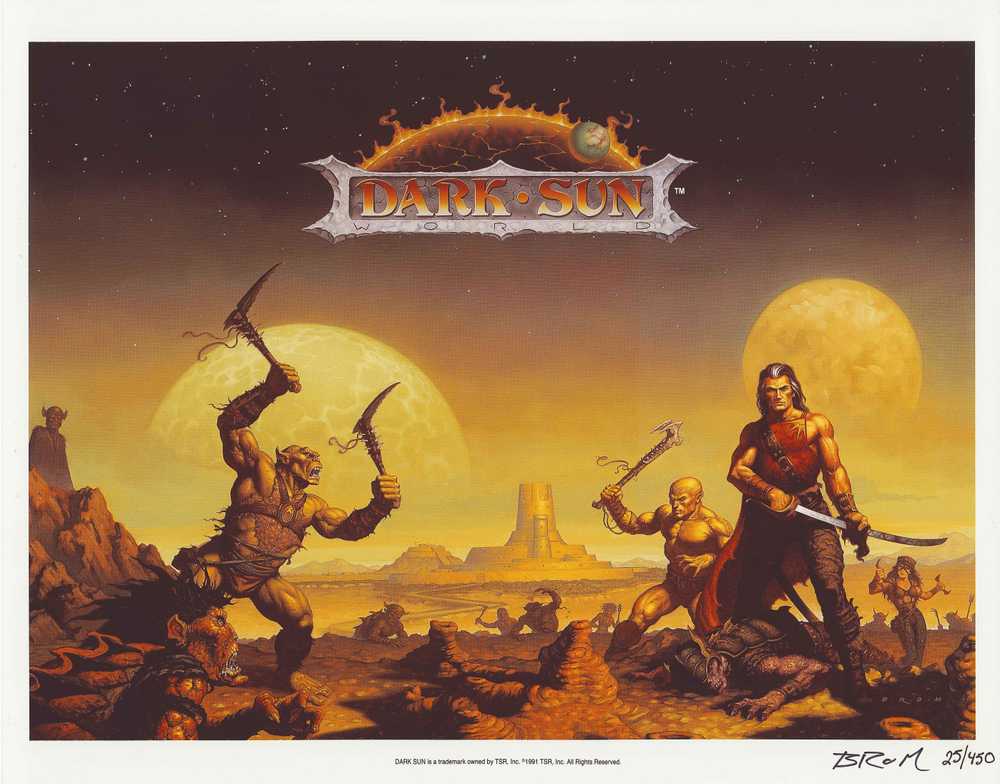
Dark Sun is a setting created in 1991 for the second edition of D&D, published by TSR (the game’s original publisher before Wizards of the Coast acquired D&D). The main designers of the original Dark Sun Boxed Set were Troy Denning and Timothy Brown. “TSR thought they needed a new game universe to replace Dragonlance,” Tim Brown tells Polygon in a video interview. “They thought it wasn’t going to last long.”
Obviously they were wrong, but that assessment led the design department to create a concept for a new campaign setting, dubbed War World. “When it came time to pick people to work on it, I was surprised that some of the more senior designers did not raise their hand,” Brown says. The premise was difficult to develop: a world devastated by war in which traditional fantasy species like elves and dwarves did not exist. “I raised my hand,” Brown says. “And so did Troy Denning.”
The two designers started putting ideas together. Their goal was to create something that felt immediately distinct from the Forgotten Realms. “I wanted to emulate the feeling of Conan,” Brown says. “I always loved how Conan’s fortunes rose and fell dramatically throughout his adventures. I also drew inspiration from other pulp stories, but I wanted an environment that resembled Dune.”
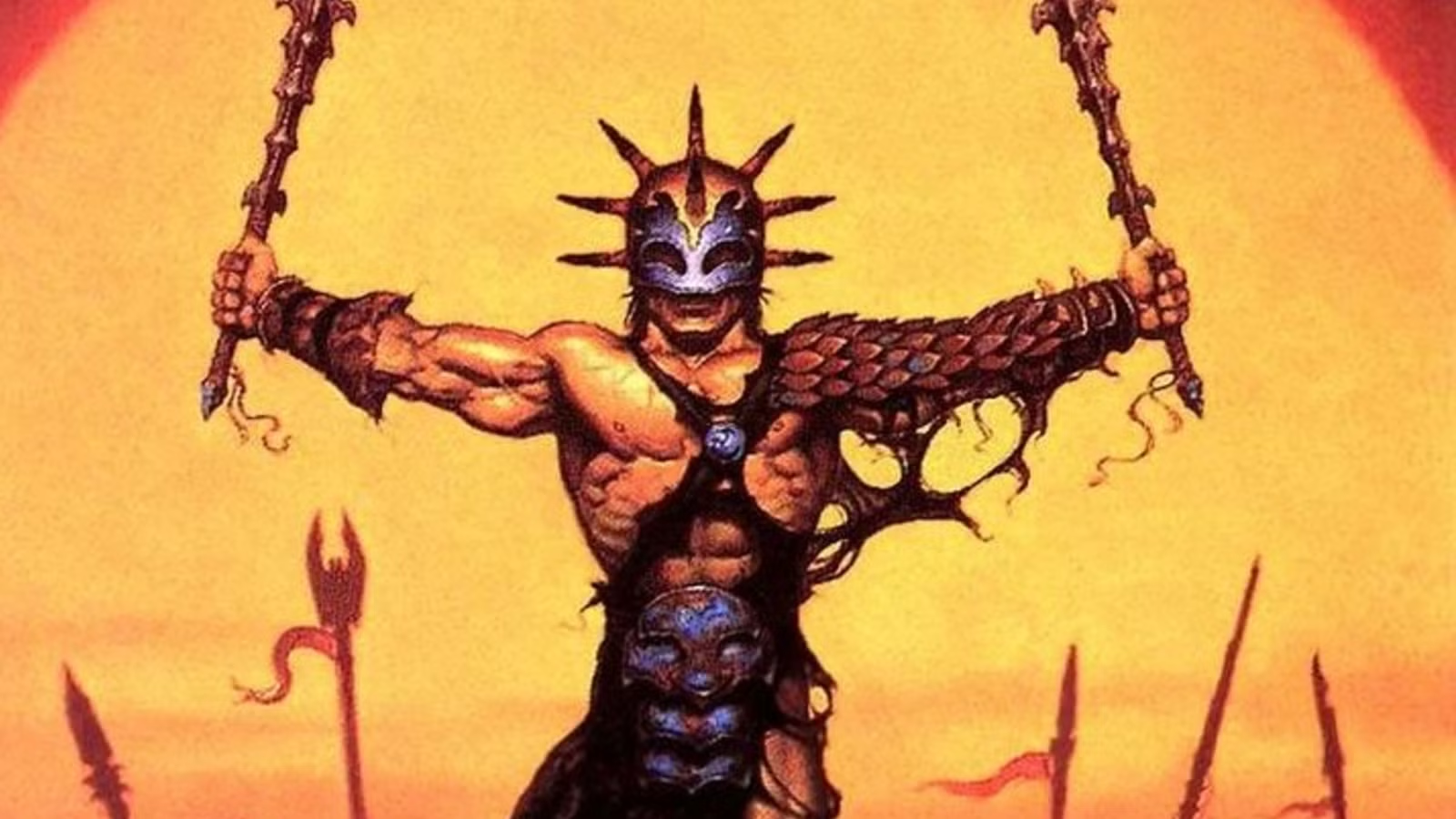
Brown recognizes that a third man played a fundamental role in developing what would become Dark Sun: Gerald Brom, a junior artist at TSR. Brown remembers that every TSR artist had their studio in the company’s offices at Lake Geneva. “Brom was a new guy, but he had some art in his portfolio that really spoke to us,” Brown says. “It looked new and cool, with a desert, harsh feel to it.”

The common understanding at the time was that writers would take the lead on a project, and the artist would draw what they wanted. But this wasn’t the case with Dark Sun. “We asked Brom: ‘While we write, please draw weird things and we’ll describe them,’” Brown says. “This was critical to the synergy that made the project work. The whole idea of metal scarcity in the setting came from Bron’s work, because he drew all these people with weapons made out of bone and bug pieces, so we thought, ‘Let’s lean into that!’”
The project quickly evolved beyond its initial concept. While the idea of a post-apocalyptic world ravaged by war remained, the designers decided to include the traditional fantasy species after all. “We did get feedback from other people, and we were convinced by a lot of other input that maybe the audience out there doesn’t want to play things that aren’t elves and dwarves and halflings,” Brown said. “So we relented, but we also thought that if we were going to keep them, we would be making them completely different. And so we did cannibal halflings, psionicist elves, and all those other weird things.”
Dark Sun was never meant to be political

In the established Dark Sun lore, every non-human species has gone through an attempted genocide at the hands of the Champions of Rajaat, 15 powerful (and mostly mad) students of the godlike (and also mad) sorcerer Rajaat. This allowed the designers to establish the post-apocalyptic nature of the world of Athas and introduce changes to established D&D species. Rajaat created “Defiling Magic,” powered by energy absorbed from the environment. Every spell sucks out life from the world, explaining why Athas is a barren wasteland.
The ultimate goal for practitioners of Defiling Magic is to transform into dragons, a process so long and grueling that only one person succeeded. In Dark Sun, the creature that is traditionally seen as the embodiment of greed is also the apex of a process that draws power from the world by destroying it. It’s hard not to see the environmental themes and a critique of capitalist greed emerging from the setting. But according to Brown, this was never the intention.

“The environment as a theme became a natural extension of deciding in advance that the world itself was very harsh, and that dealing with that environment to stay alive every day was going to be much more important than it is, say, the Forgotten Realms, where you’re not too worried about finding food or water,” Brown says. “In Dark Sun, we wanted players to deal with this. And if the world is in decline, then environmental themes seem like a natural fit: the scarcity of resources and their hoarding by the rich, so that the poor suffer to the point that, in Dark Sun, they become slaves.”
Enslavement is another big topic that often comes up when discussing Dark Sun. Wizards of the Coast has notoriously stayed away from the setting for a long time to avoid the controversy. According to recent statements, the upcoming new line of Dark Sun books will also avoid mentions of slavery and change the setting accordingly. But Brown says that Dark Sun was never meant to be political.
“I can’t remember a single conversation with Troy or with Brom where we said, ‘Hey, we’re trying to take a political stand with this game.’ That was never the issue. It all had to do with a collapsing environment, and if that is indicative of things that are going on in our real world, well, that’s for anyone to interpret.”
Brown also mentions being surprised that people latched on to Dark Sun’s political themes so much. “There was no internet as we understand it today in 1991,” Brown says. “So if people were having a political reaction to Dark Sun in the early ‘90s, I didn’t know about it. As everything else in the world got politicized in online conversations, Dark Sun became politicized as well. What we wrote touched nerves here and there. That’s not always the designers’ wish, but sometimes that happens.”
Brown has similar thoughts on the slavery controversy. “Our goal in creating Dark Sun was to always view good and evil, and lawful and unlawful, as natural consequences of all the activities in the world,” Brown says. “We had no problem putting slavery in, given that it is always defined as something that is evil, and that the good characters are going to fight against that.”
From Brown’s responses, it seems the designers didn’t consider the product potentially insensitive to real-world histories of slavery. They made it a matter of good versus evil, assuming the player characters would be on the side of good. “Maybe part of what makes people uneasy is that slavery in Dark Sun is most definitely humans enslaving other humans,” Brown says. “Whereas in other fantasy settings, goblins who capture people are probably enslaving them all the time, but they’re evil creatures.”
A spiritual successor to Dark Sun is coming, and it will be even more brutal

One of the elements that made Dark Sun so unique and enduring among fans is that magic is literally woven into the world — usually in a destructive way. The idea that even the most basic spell has a cost, one that is paid for by the world itself, represents a pioneering integration of in-game mechanics and metaplot. Brown’s new project, Dragon Kings, published by Strange Owl Games, takes that premise to a whole new level.
Coming from Dark Sun’s original creators, including Timothy Brown, Troy Denning, Ferald Brom, Bill Slavicsek, Rich Baker, and Shane Hensley, Dragon Kings is a follow-up to Brown’s 2014 project of the same name that introduced the world of Khitus, presented as a spiritual successor to Dark Sun.
“Shane Hensley and I approached Wizards of the Coast a few times to sell us Dark Sun, and they always refused,” Brown says. “So we decided we would just make our own spiritual successor, and it was a lot of fun. This is an updated version that brings Dragon Kings up to the current 5th edition D&D rules, and expands it quite a bit.”

The world of Khitus is more hopeful compared to Athas, but there are many similarities, including the scarcity of resources and the consequences for casting magic. But while Dark Sun made the whole planet pay the toll, magic in Dragon Kings has more personal but no less cruel effects.
“Thematically, I’m a big fan that casting magic should have more consequences for people,” Brown says. “In Dragon Kings, magic itself is a living entity and it doesn’t want to be bothered. So if you cast spells, you’re risking magic taking out its wrath upon you, and if it can’t get to you, it gets the people around you and the things and people you love. All of your loved ones are at risk every time you cast a spell.”
It’s already an absolutely brutal concept, but it gets worse. “So sorcery’s wrath is something to be mitigated. Wizards have figured out various ways to deal with this,” Brown says. “Some of the worst of them keep a chain of drugged captives that they’re dragging along with them, who are forced to love the wizard. And when sorcery comes after them, it often takes out one of those people instead.”
Brown could not anticipate that a new Wizards of the Coast Dark Sun line would be announced at the same time as Dragon Kings, but he wants to stress that the latter is more than just a nod to the “original” Dark Sun. New mechanics and worldbuilding elements stand out on their own.

“We have a ‘desperation system’ that goes up according to your actions or what’s going on in the world, and that value then influences specific elements of gameplay,” Brown says. “The more desperate things become, the harder it is to get something done, so you might want to take actions to lower the desperation value.”
For the true nostalgics, a separate Dragon Kings product will present conversion guidelines to play the setting under D&D 2nd edition rules. If Wizards of the Coast’s new spin on Dark Sun isn’t your jam, check out Dragon Kings’ BackerKit campaign. The project is already funded, but the campaign will end on Nov. 5.