
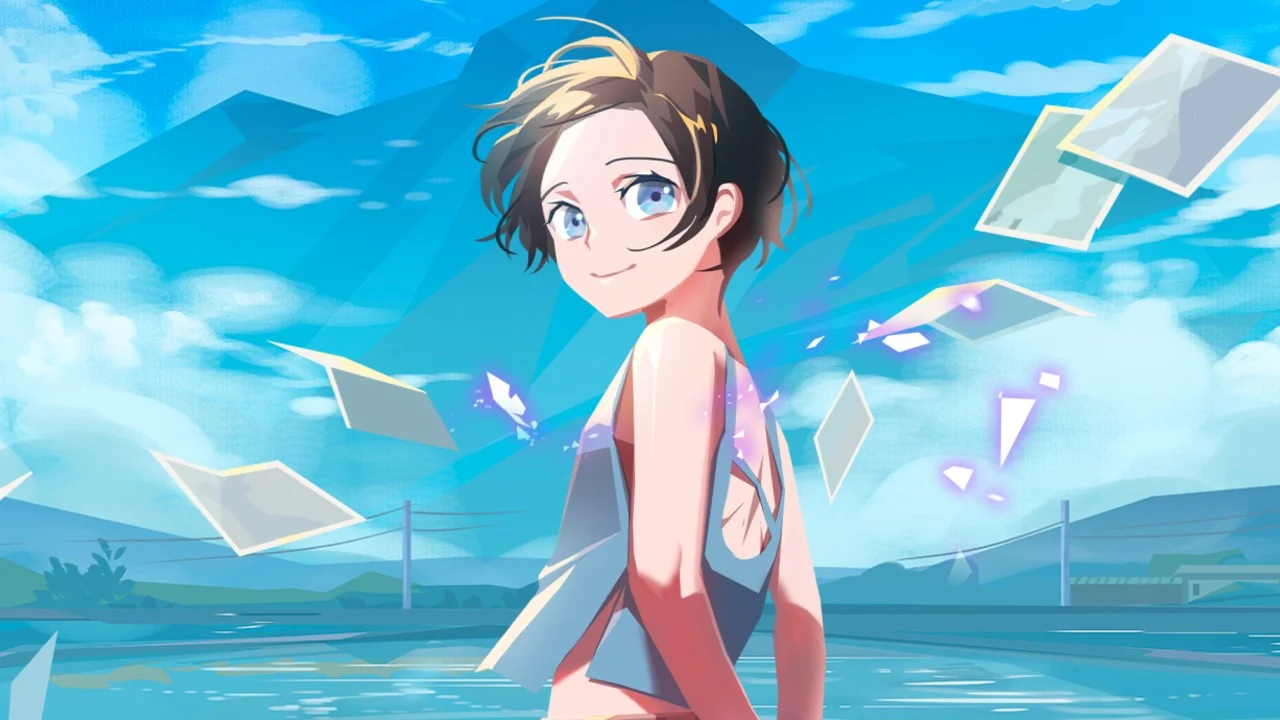

In OPUS: Prism Peak, Eugene blames himself for everything.
When he remembers his past, he focuses on his regrets, the big moments. The fights between his parents. His failed photography career. His collapsed marriage. His unsuccessful cafe. In his eyes, all of these letdowns are because of him, and as a result, he’s left aimlessly drifting through life at 40 years old.
But there is one light: his grandfather, and his love of the camera. Eugene’s grandpa gave him a reprieve and an outlet through the lens. But eventually, Eugene gives it up. He’s a failure.
But the camera is everything in Prism Peak. It’s the signature gameplay mechanic, the narrative device telling Eugene’s story, and the lens through which I (and Eugene) come to understand the Dusklands, a mystical world where animals speak and a young girl named Ren wants to return home, which is at the top of a mountain.

Eugene ends up here after getting in a car crash on the way to his grandfather’s funeral. It’s a Studio Ghibli-esque world with characters who wouldn’t be out of place in Spirited Away, and landscapes that evoke Hayao Miyazaki’s love of the Japanese countryside. There’s a boar who is a train conductor, and a pangolin who is shy but reliable. All you have to do is explore and take photos.
And so I do, armed with Eugene’s beloved camera and a notebook where I spend time deciphering the language of this world and understanding its animal residents. Sometimes I’ll paste photos in there that correspond with a character, other times I’ll be writing out the story of the Dusklands as I stick murals within my pages.
Taking photos is very easy, but eventually you unlock the option to change lenses, shutter speed, and even devices that tell you how dim or bright your photo is. The lenses feel like a bit of an afterthought — most are aesthetic choices, save for one which you’ll never take off once you unlock it — but everything else turns the photography aspect into a bit of a puzzle. Are you too close to the object? Do you need to focus more? Is the lens dirty? Why can’t you see the runes on this rock?

The camera forces you to look and observe because you have to do things with those photos. Besides your journal, you also have to interact with Firebowls which pose riddles for you to solve with the corresponding photograph. You can drop seeds in to unlock extra pages for your book or camera lenses, and you can collect ash by making the wrong choices, which you then use to fill out your book.
Eventually, wooden totems representing the animals you meet gather around the fire, and they have their own riddles and requests that you can meet to fill out their entries in your book. With these, it can be pretty easy to miss the subjects you need to photograph, but completing these is also crucial to reaching the true ending.
At one point, I accidentally progressed the story even though I hadn’t stopped exploring an area, and in Prism Peak, you can’t go back to previous sections ever, meaning I’d locked myself out of the true ending pretty early on. Sometimes, the object you need to take a photo of isn’t interactable, so the game really tests your observation skills – as it should! But I wish there were an easier way to discern what I needed to interact with.

Especially because every photo you take, everything you look at, acts as a reminder of Eugene’s life. Not all of them are pleasant. Death. Fights. Missed connections. Every snapshot is a moment of frozen time that represents or reminds Eugene of something he’s tried to forget. A lot of this is optional, unless you’re going for the true ending, but filling out this scrapbook only enriches the narrative and Eugene as a character.
The more important photos come up in his dreams where he enters the Dusklands; these black and white vignettes emphasise the important moments of his life, tying together the threads you’ve been pulling in each location. OPUS: Prism Peak isn’t shy about its subjects and is liberal with its emotions: I smiled, laughed, and cried throughout. But it also doesn’t smack you around the face with them.
Those emotions crept up on me the more and more I played. The more animal friends I spoke to. The more pictures I took. The more I understood Eugene and Ren. The charm and beauty of Prism Peak led me on a journey of my own self-reflection, and eventually, I was walking through scenes with a lump in my throat, a tear in my eye. I could see what was coming next, and I knew I — and Eugene — had to confront each scene.

For the first time ever, I felt like I was playing and experiencing a lost Ghibli movie. For once, it goes beyond the aesthetics and the quirky characters; thematically, emotionally, and spiritually, this could easily be the next move in Miyazaki’s library. Lots of games claim to be inspired by Ghibli, but developer Sigono actually nails the feeling.
It also nails the look, without feeling derivative. Screenshots tell part of the story, but Prism Peak is absolutely gorgeous in motion, too. Soft colour palettes help the lush country and woods meld with the ruins of the cities and buildings you’ll explore throughout. When things get more sinister, the slow fade of soft pinks, greens, and browns into blacks and reds instils a sense of dread in me. I wanted to see all this world had to offer, and the visuals only enticed me more.
Which makes the Switch 2 version more than a little disappointing. For the most part, the game looks great both docked and handheld, but the frame rate is incredibly inconsistent. In busier scenes full of swaying grass and trees, the frame rate dipped below 20fps. While in some interior sections, it managed above 50fps. But it fluctuates constantly, which can be a little distracting in some of the chase sequences peppered throughout the game.

Character shadows look jagged close-up, and a few textures are a little blurry, too, putting a bit of a tarnish on the game as it is now on the console. Luckily, the developer is working on a patch for this, and has acknowledged a handful of other issues (which I didn’t encounter), so things should be better in the near future.
Which is good, because OPUS: Prism Peak deserves to be seen and experienced in the best possible light. Even though there’s sadness throughout, I wouldn’t call it a sad game: it’s one of the most spiritual and beautiful games I’ve played. Maybe just wait until that patch.
Conclusion
Sigono has proven once again that it understands powerful emotional storytelling with OPUS: Prism Peak, a game about self-reflection, acknowledging what’s come before, and moving on. It’s the most Studio Ghibli-like game I’ve ever played, in a way that goes beyond aesthetics.
If you’re not careful, it’s easy to miss some crucial unlockables and some of the game’s best moments; a second run-through might be quicker, but it still requires you to play at a particular pace. And the Switch 2 isn’t the best way to play at the time of writing, but once it’s fully developed, there are few better story and character-driven experiences on the console than this.