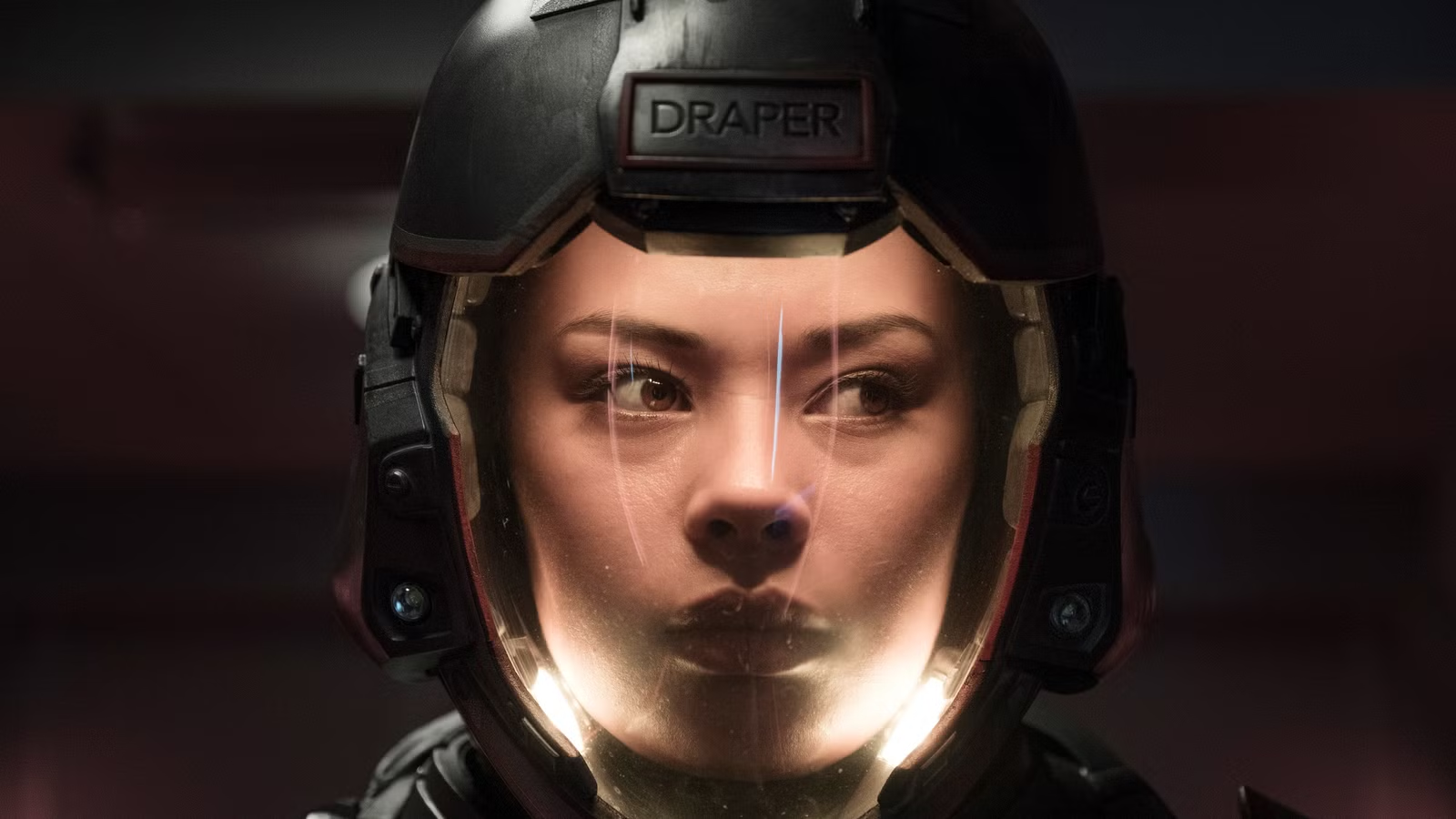
When Syfy began adapting Daniel Abraham and Ty Franck’s space-opera novels The Expanse for television, the authors (who write together under the name James S.A. Corey) were closely involved in the process. Over six seasons and a shift to Prime Video, Franck and Abraham served as screenwriters, producers, media ambassadors, and even walk-on actors.
Abraham and Franck are set to have an even bigger role in the developing adaptation of their current book series, The Captive’s War. In 2024, they formed a production company, Expanding Universe, to produce the show, and they already have a development deal with Amazon. But the duo tells Polygon that knowing they’re writing for the screen as well as the page this time around didn’t change their plotting or process at all — which is going to cause a lot of problems in adapting the series for TV.
“It really annoyed and confused our showrunner, because we made it so freaking hard to adapt into a TV show,” Abraham says. “The Captive’s War has a lot of things that would need a lot of work before they turn it into a screenplay: a lot of interiority in the characters, a lot of amazing, spectacular aliens. All of that stuff is challenging. And yeah, we just leaned right into it. We didn’t make it easy.”
‘A lot of amazing, spectacular aliens’

The Captive’s War trilogy launched in 2024 with The Mercy of Gods. (Read the first chapter here.) It takes place in a universe dominated by the Carryx, a quasi-insectoid species that roams the galaxy, capturing entire sentient populations and testing them to see if they’re “useful.” Useful species are pressed into slavery; useless species (including those that are rebellious, disruptive, or otherwise incapable of adapting to Carryx rule) are destroyed en masse, sometimes with planet-razing weaponry.
When the Carryx invade the human planet of Anjiin, a group of lab workers that have just had a breakthrough on a potentially universe-shifting project are among the thousands impressed into service. They’re forcibly relocated to an immense, cathedral-like city called the “world-palace,” where dozens, maybe hundreds of wildly diverse alien species interact. That setting and the alien element could potentially make The Captive’s War far more expensive to put on screens than The Expanse, which has a sprawling cast across multiple planets, but is focused on human characters.
But in spite of Franck and Abraham’s experience on The Expanse, Franck says they didn’t start Captive’s War with any adaptation plan in mind.
“We were either done or mostly done with the first book before we had the discussions about adaptation,” he says. “So we weren’t writing a book and a screenplay of that book in parallel. So far, we’ve never done that.”
He adds that they’re so early in the development process for an adaptation that they haven’t even started considering questions like “How are you going to put all these aliens on screen?”
“The reality is that adaptation is a million tiny little blocks stacked on top of each other,” Franck says. “At this point, I think we’ve stacked the third block. So there’s, like, thousands of blocks to go before anybody would go, ‘OK, so now let’s talk visual effects.’ At this point, we’re talking about things like, ‘Do we write a script?’”
‘A lot of interiority in the characters’

One of the most fascinating aspects of Captive’s War comes from a character who’s just part of a large ensemble in The Mercy of Gods, but who emerges as a primary protagonist by book two, The Faith of Beasts. (Read the first chapter here.)
Dafyd Alkhor, a low-level lab researcher who responds to captivity by trying to understand Carryx society and learn how to manipulate it, winds up as humanity’s designated ambassador to the Carryx, responsible for anything the other human captives do.
That leads him to acts that he sees as necessary for human survival, but that his fellow captives see as complicity or atrocity. The gap between how he sees himself and how other people see him, and the constant shifts in both those perspectives, makes for gripping reading. Abraham says writing him isn’t nearly as complicated as it sounds, though: “It just feels like reportage.”
“Yeah, I mean, it’s just history,” Franck says. “The difference between hero and villain is who’s writing the reporting. All of our greatest heroes did awful, awful things. And we tend to sanitize that in our histories, but if you go and read the original sources, there’s some pretty dark shit in there. So we didn’t want to shy away from that.”
Franck points out that The Mercy of Gods states on page one that Dafyd “is going to be responsible for an enormous amount of violence in the universe to achieve his goals. You can’t make that guy a saint. His hands cannot possibly be clean. So we wanted to be very honest about what it takes to change the world in that way — the kind of violence you have to do, not only to the world around you, but to the people around you. And to yourself — the sort of ethical violence you have to do to yourself.”

Abraham points out the “long history of protagonists who are at odds with their own personas,” particularly Captain Hornblower from C.S. Forester’s Hornblower books, who he describes as a coward who “overcompensated into these acts of tremendous heroism, driven by this insecurity that you got to be part of, because you were the reader — everybody else just saw him doing the amazing stuff.”
He sees similar conflicts in Patricia Highsmith’s criminal protagonist Tom Ripley, and Orson Scott Card’s Ender Wiggin — “he’s sympathetic and a monster. There’s a wonderful tension that comes when you have somebody’s interiority, and you also have what the world around them thinks of them, and those two don’t sync up.”
It’ll be impossible to put that on screen as it appears in the books, since one of Dafyd’s crucial characteristics is the secret guilt he feels about some of his brutal leadership choices. He can’t widely admit to his doubts and miseries — he has to maintain an appearance of strength and confidence, and he’s aware that the people he’s trying to keep alive with his cold equations don’t want to hear his justifications or his complaints about his own suffering. But he feels every necessary cruelty keenly. Franck and Abraham are fine with losing the nuance of Dafyd’s inner life on the screen, though, after doing something similar in The Expanse.
“It’s not the first time we’ve had to do that,” Abraham says. “If you read [the first Expanse novel,] Leviathan Wakes, Miller is a character who sits around and feels sorry for himself and drinks and thinks a lot. The actual version of him we had in the book would have been terrible to film. So you find other ways to portray that, that a camera can see. And you get Thomas Jane [to play him]. Then you wind up with something that achieves the same effect with a different toolbox.”
Lessons learned from adapting The Expanse for TV

In terms of any lessons learned while working on The Expanse as a TV show, Franck says the biggest one was limiting how long Captive’s War would run as a book series. (They insist it’s just going to be a trilogy, in spite of the story’s intimidating scope.)
“We didn’t want to write nine books [this time],” Franck says. “You get to about the fourth or fifth book, and you go, ‘Jesus, we got four more of these things to do.’”
“We were in production by the time we were doing book five,” Abraham says. “It was exhausting, sending Ty off to do 12- and 14-hour days on set, and still trying to make our deadlines on the books. It was brutal. So [we wanted to write] something of a smaller scope than The Expanse.”

With The Captive’s War, they may be setting a high difficulty bar for themselves as screenwriters and producers down the line, but they feel it’s worth it to get to play around with a kind of story they couldn’t fit into their previous series.
“We were just ready to try a different corner of space opera,” Abraham says. “We were looking to do something that felt more like the great “galactic empires” settings, like you see in Frank Herbert’s Dune, like you see in [Iain M. Banks’] Culture novels, and get into a space we hadn’t been before.”
He says The Expanse let him and Franck “play in a whole bunch of different genres,” because science fiction is flexible enough to contain any other genre.
“You get to do almost any kind of story there,” he says. “The story we’re telling in Captive’s War fits gracefully in science fiction, but would not have fit gracefully in The Expanse. We may have other stories down the line, like, what does a crime novel look like in space opera? What does a romance novel look like in space opera? There are all those things you can play with, and still fold it into those settings and those tropes.”
The first two Captive’s War novels, The Mercy of Gods and The Faith of Beasts, are available in physical and online bookstores now.

The Expanse creators don’t want their new series to fall into a Star Wars rut
‘Star Wars is never going to stop. And Star Trek is the same way. If you have a big universe, it is expected you will just keep dipping in that well.’