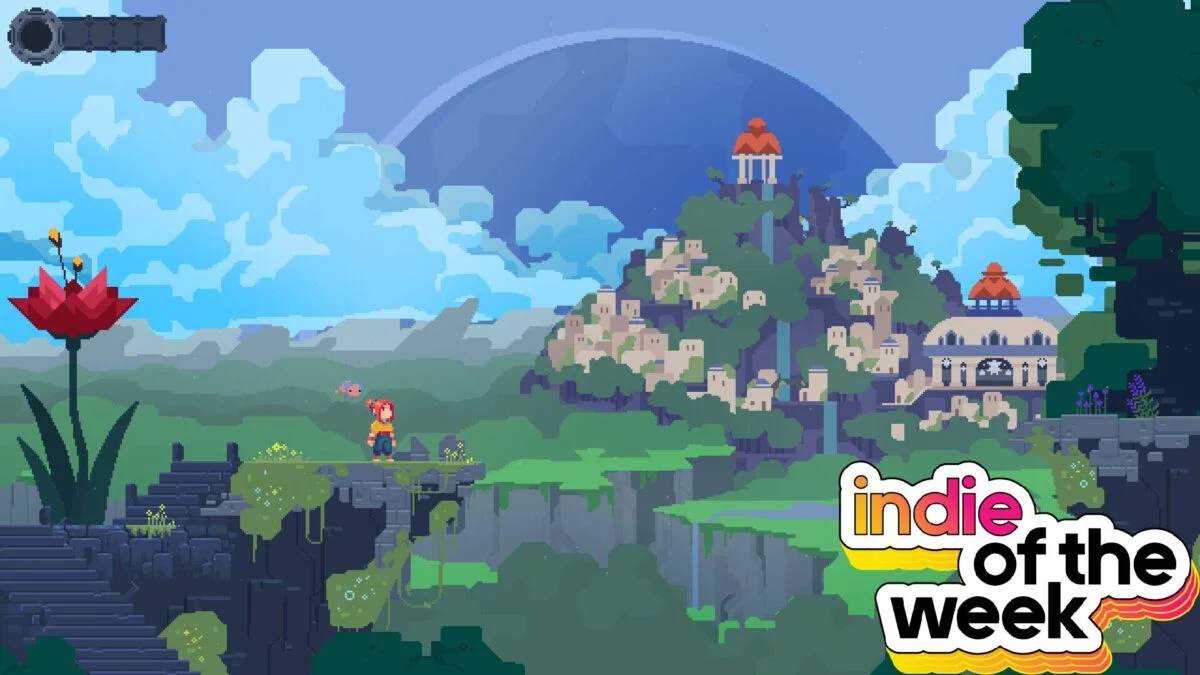
I just got done with several laidback, forgiving games back-to-back. Which means it’s time to play something that’s going to piss me off, ideally by putting me in situations where I die a lot but also feel powerfully compelled to continue playing. Fortunately, Tethergeist from O. and Co. Games and Out of Space Games came out last month, and it’s got so many deadly spike pits to fall into, folks.
Tethergeist‘s main character is Mae, a girl living in a community where everyone is capable of astral projection. Mae is preparing for her coming-of-age ceremony, which traditionally has its participants astral-projecting themselves on a pilgrimage outside the village. But Mae’s a little different from the others: her astral-projected form is tied to her physical body with a tether, and thus can’t get too far away from its host.
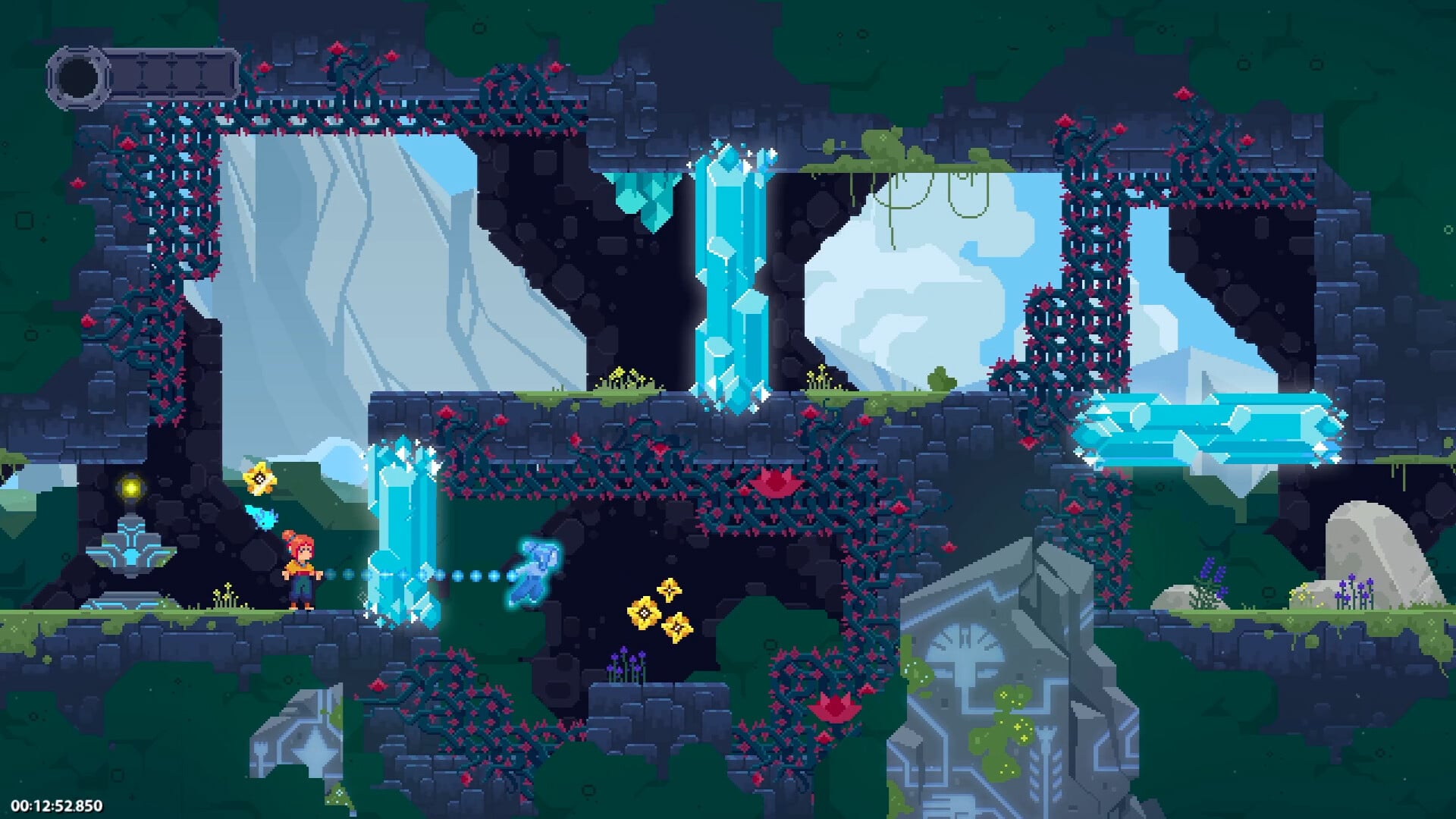
Mae chooses to undertake the journey on foot with the help of her tether. What ensues is an extremely Celeste-inspired puzzle platformer that’s got some really cool ideas. For instance, Mae’s body cannot pass through sharp thorns or large blocks of magic crystal. But her spirit can, and if she astral projects it through the obstacle, her body is then yanked to the other side to join her spirit when she breaks her meditation. She can begin astral projection while airborne, causing her body to drift slowly downward, leading to some interesting platforming segments in which you have to jump, project yourself around some obstacles, and then release before Mae either lands in spikes or gets too far away from her spirit to continue.
Things get more complex as they go along. For instance, Mae must collect yellow flowers on each screen in order to astral-project, leading to some puzzles that require clever use of limited projections. There are platforms that only move when she’s projecting. She can wall-kick. There are spaces of weird red energy where she can’t astral-project at all, but if she’s already projecting from elsewhere, her spirit can still move through them. There are floors with spikes that only jut out when you’re projecting, but disappear when you’re not. A little further in, there are these weird mushroom things you can use to bounce up and down, and goofy jellyfish things that can launch you, body and soul, in a direction. Taken all together, these mechanics mix up into some real nice, bouncy levels where you’re spending more time in the air than on the ground.
Tethergeist steadily layers in new mechanics, doing an excellent job of first teaching you how something works, and then starting to combine it with things you’ve already seen before for increasingly complex puzzles. And it helps that it controls really nicely. Once you get the hang of Mae’s limits, it gets easier to sightread what a given level wants you to do with her capabilities, leaving only the often-challenging execution of spiriting yourself across a map. It’s simple, I know, but I love when games like this give me a lot of small screens on which to master a mechanic, followed by a few increasingly long screens so that by the time I finish the area I feel mentally out of breath, but thrilled, like I’ve just completed a marathon by managing to stay in the air and out of the spikes for 10 obstacles running or so.
Taking cues from Celeste, Tethergeist is forgiving in that most puzzles are localized to a single screen, and there are unlimited lives. If you die, you just respawn at the start of the screen and try again. And there are hidden red flowers dotted across all the levels, similar to Celeste‘s strawberries, for those who want an extra challenge. Some of them are locked behind tough platforming, while others are just hidden in the environment in clever ways, or involve sitting for a moment and puzzling through your own abilities to figure out how best to reach them. In the first area alone I think I missed like ten of them, which gives me a strong incentive to go back and explore more once I become even more confident in my projecting abilities.
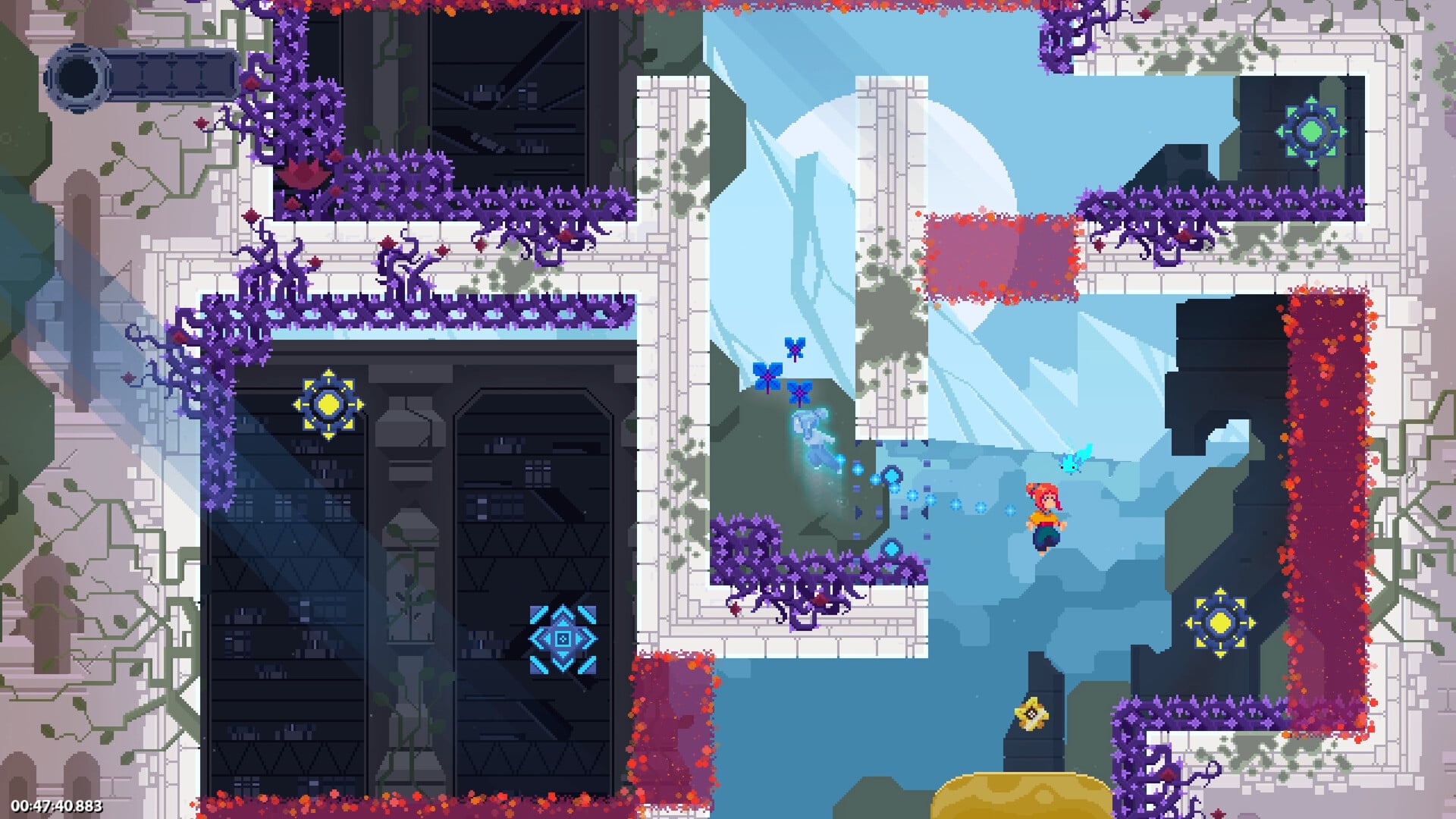
I like what Tethergeist is selling here. It’s unapologetically inspired by Maddy Thorson’s indie hit, but it’s also very cleanly and clearly doing its own spin on it, and it really, really works. It’s got lovely art and animation, wonderfully colorful levels with a lot of variety and a good, steady escalation of difficulty, and a serene soundtrack to ensure I don’t get too mad when I die a lot. The little “pop” sounds of projecting, returning, bouncing, and even dying are deeply satisfying and add a nice rhythm to the stages. And I think there’s a lot of potential for an interesting story here, too, about both disability and capability, about a girl on the cusp of adulthood who desperately wants to communicate that she’s just as capable as her peers, just in a way that looks a bit different from theirs.
There’s also a very cute axolotl spirit palling around with Mae. Its name is Bao. I thought that was important for you to know, too. Tethergeist is out now on PC and Nintendo Switch.