
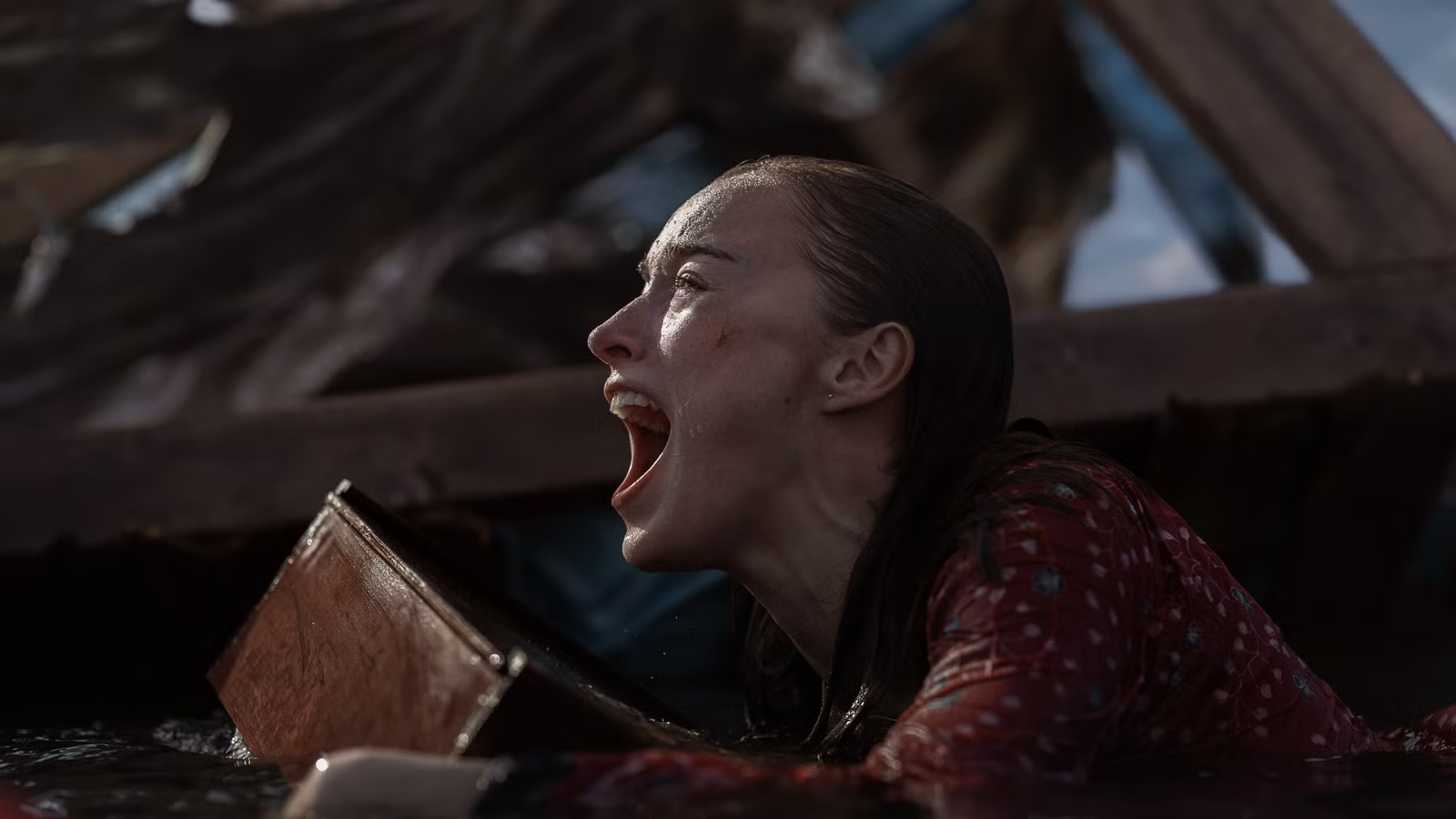
Typically, it takes years of neglect for a house to really look haunted, whether or not it actually has ghosts lurking around every corner. Nature, however, can get that job done with greater, terrifying efficiency. In Tommy Wirkola’s Netflix horror-thriller Thrash, a hurricane and its attendant flooding descends on a small town in South Carolina, and once-livable homes are quickly rendered waterlogged and creaky. Beds float (just like in a demonic possession!) and flooded basements become eerie danger zones. There’s also an element of urban-legend surrealism when a school of sharks swims in with the ocean waters, stalking the flooded streets and houses, menacing a series of trapped residents.
If you think this sounds a little bit like Alexandre Aja’s 2019 movie Crawl, where a young woman braves a hurricane and a group of alligators to rescue her stranded father, you’re mistaken. It’s actually a lot like the movie Crawl, to the point where it feels like a brainstorming session for a sequel. (An actual sequel to Crawl has been discussed, but this isn’t it.) What if we tried sharks instead of alligators? What if instead of a father and a daughter, it was a mother-to-be and a young-adult orphan? What if we kept the father, but made him a bad foster dad, and turned the young woman into three younger kids? Writer-director Wirkola (Dead Snow, the Pixar-esque animated sperm adventure Spermageddon) considers these scenarios, then chooses all of them.
This decision diffuses the tension of Crawl, which benefited from mostly sticking to a firm point of view. It also helped that Alexandre Aja has become a reliable B-movie craftsman. Wirkola, meanwhile, hedges his bets between Lisa (Phoebe Dynevor), a very pregnant woman who decides to leave town too late and encounters blocked roads; Dakota (Whitney Peak), an agoraphobic young woman still reeling from her mother’s death, and attempting to ride out the storm at home; Dale (Djimon Hounsou), Dakota’s uncle, a marine researcher who ventures out to save her; and a trio of siblings (Alyla Browne, Stacy Clausen, Dante Ubaldi) whose neglectful foster parents haven’t taken the threat seriously enough.

Cutting between these stories, and observing how some of them intersect (as well as how Wirkola serves up side-character chum for the encroaching sharks) keeps Thrash moving through its slim 79 minutes of actual runtime. (In an amusing attempt at padding the movie to its official 86 minutes, some of the actors and filmmakers are credited two or three times.) But Wirkola doesn’t cut between the stories in a way that ratchets up tension; he’s more talented at moving things along than actually wringing the maximum suspense out of every scene. That was also true of his winky horror-fantasy-comedies Hansel and Gretel: Witch Hunters and Violent Night, which were slickly constructed around the question “What if a fairy tale had a lot of CG blood?”
On that level, Thrash is less prone to smirking than Wirkola’s previous American films, and apart from some truly dodgy daytime shots of characters in boats, the use of CG in faking a dangerous storm and flood is more effective. The sharks don’t look great, but they’re better deployed than in the film’s janky Netflix cousin Under Paris.
This movie, by contrast, was originally intended for theaters, which might explain its stronger visuals. The tone, however, is less consistent. Is this a sobering environmental-consequences thriller, as producer Adam McKay might prefer? Is it doomy satire, like what McKay himself made out of Don’t Look Up? (It’s hard to parse what avowed left-winger McKay made of the plot detail that the foster kids’ parents are essentially welfare cheats.) Is it supposed to be funny and self-aware, as indicated by a late-movie montage of weapons assemblage? Or a purer B-movie blast like Crawl? As with its various survival scenarios, the movie tries all of the above, right through its abrupt final stinger.

Thrash is most successful when it goes for straightforward thrills, as in a scene where the kids must figure out how to distract some sharks, swim into their blooded basement, retrieve some crucial gear, and make it back up to their almost-submerged kitchen-counter perch before the creatures come after them. The movie also deserves some exploitation credit for actually having a woman give birth in shark-infested floodwaters, reaching levels of child-endangerment shamelessness rarely seen in mainstream movies.
In a perverse way, you must respect the movie’s commitment to upping the ante, even if the childbirth sequence itself could have been more horrifically drawn out given its supremely uncomfortable location.That’s more broadly true of Thrash as a whole, actually. It doesn’t capture the full horror potential of climate change, rising floodwaters, or even bloodthirsty sharks. But the filmmakers sure throw themselves into the fray with enthusiasm.
Thrash is streaming on Netflix now.