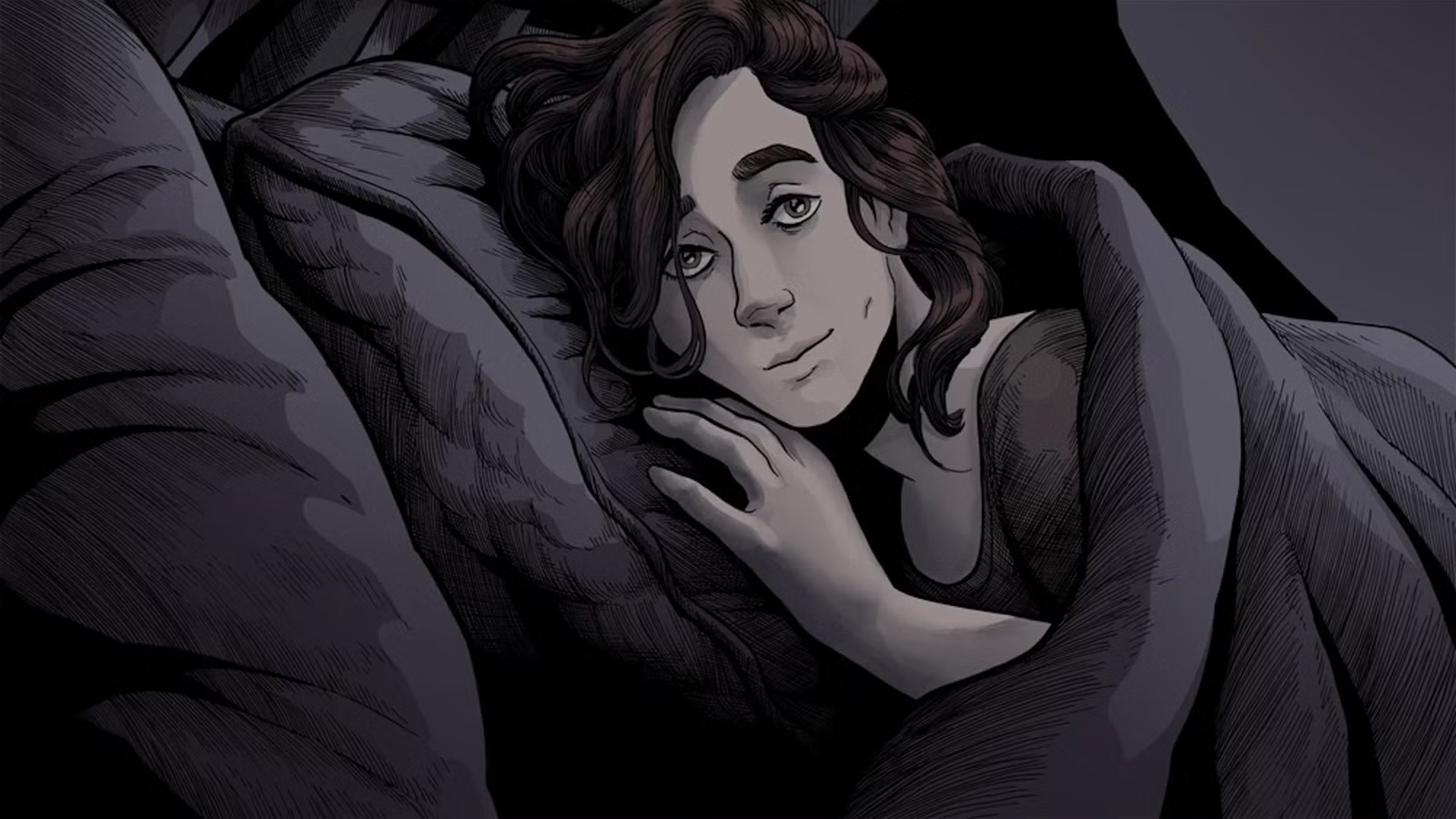
RPGs have a relationship problem, and it’s all about you. You help someone for a reward. You encourage someone to change so they suit your preferences. You make someone love you because you picked the right things to say. For Abby Howard and Tony Howard-Arias of Black Tabby Games, putting you at the center of relationships makes friendships and romances shallow. So for their horror RPG-slash-visual novel Scarlet Hollow, they set out to find a solution.
“In some RPGs, like Mass Effect, you lead a conversation that’s about the other character, but it’s also about you and how you can fix their problems,” Howard-Arias says. “And it’s just this very solipsist structure, where a player feels like the only real person in this setting because the flow of time, the progression of events, agency itself, is only really assigned to the player. So we wanted to see: what does an exploration look like if it’s the other characters who are expressing this agency and you’re at their whim?”
Scarlet Hollow follows a young adult visiting their family home in rural North Carolina, but ancient gods start mucking around with things and folks get a bit weirder than usual. Howard decided on a small town for Scarlet Hollow‘s setting based in part on her experience growing up in North Carolina (and also her love of Southern Gothic literature). But to Howard-Arias, who grew up in New Jersey, “small town” meant “Bruce Springsteen.” So he dug into Springsteen’s discography and came back up with themes of escapism, a desire to flee to something bigger and better as his central focus. That, and its counterpoint: not being able to flee for something better.
The pair used that as a starting point for exploring what it means to feel trapped in your life. Trapped by your family and the choices they made decades before you even existed. Trapped by the way your parents raised you, so you reproduce their relationship models without even realizing it, for better or worse. Trapped by everyone’s expectations, their views of you that will never change, because you can’t reinvent yourself and neither can they. This web of problems and context is the most influential factor determining how people interact with you in Scarlet Hollow.

And that phrasing is important — how they interact with you. Not how you change their lives. You can alter how their lives play out, but you’ll never quite be able to predict how your choices might interact with all the other messes that made them who they are.
“A childish aspect of games as an artistic medium is that the vast majority of stories and games are about heroism and doing the right thing,” Howard-Arias says. “With Scarlet Hollow, I felt like I needed to ask the question, what is good without sacrifice? What are we doing as an artistic medium if we’re saying these are stories about heroism, but there’s no stakes, there’s no penalties, there is nothing risked for the greater good? There is no self-sacrifice, no examination of human nature. It’s a power fantasy that rewards you with a better outcome for doing the right thing.”
“In terms of character relationships, that means making certain choices is going to impact your relationship with other people, sometimes for the good, sometimes for the bad, dependent on what you did to their lives,” Howard adds.
There is no golden route, in other words. There’s no magic solution that makes everyone happy with you. Picking one thing means giving up another, and the interconnectedness of everything in Scarlet Hollow means what you’re giving up could be just as good or important as what you chose.
There’s one small exception. Howard and Howard-Arias intentionally created a single instance of what you might call an ideal outcome… and made it exceptionally hard to achieve. In Scarlet Hollow‘s fifth chapter, which was released in February, you can make Tabitha cry in a therapeutic kind of way. Tabitha is your cousin in the game, someone who expresses few positive emotions and, at a glance, seems like the villain of the piece. She isn’t, as there are no definitive “bad guys” in Scarlet Hollow, but it takes a specific set of actions throughout the game up to chapter five to break through her shell — the kind of task that you’d probably need a wiki for.
Even that was an exercise in showing how fluid personalities can be. Other RPGs might treat the “make Tabitha cry” moment as a pivotal turning point, the essential step toward reaching a good ending. Scarlet Hollow does make it influence her behavior for the rest of the chapter. But it’s not the only factor. Some of the choices Tabitha makes after the weeping scenario are also affected by how you’ve behaved up to that moment. But ultimately, it’s about her — not you.

The uncertain impact you’re having on someone’s life holds true for every relationship in Scarlet Hollow, not just romantic ones. But those have an extra layer of difficulty. Howard and Howard-Arias aren’t happy with a trend they see in modern media, where close relationships have no friction. Problems are resolved simply by talking about them, since everyone involved wants the same thing, and all it takes to fix someone’s flaw is pointing out that it exists.
“Then they’ll be like, ‘Oh my god, I’m so sorry I had a flaw. I’ll stop having it right away,” Howard laughs. “And that is not how it works. Or you might have three really good dates with someone and feel really close to them, feel the sparks and puppy love, and then you hit a wall where you want fundamentally different things. And where do you go from there? How do you resolve that? That’s where the realness comes from.”
All of Scarlet Hollow‘s romantic relationships follow that pattern, where you eventually run into some immutable trait or fervent desire the other person has, then have to figure out what that means for the way you see your relationship. Stella, the first friend you make in Scarlet Hollow, will always want to talk to Tabitha in chapter five about what’s happening, even if you don’t want her to, and even if it leads to very poor outcomes (which it often does). Oscar, the librarian, has a unique way of showing affection: letting you see how weird he can be (and he can be pretty weird). It’s not good. It’s not bad. It just is, and you can’t change it.
The same is true for Scarlet Hollow‘s other love interests, to varying degrees. Depending on the person and the route you end up with, it might be harder not to label certain actions as less than good. Just because you want what’s best for your friends and lover doesn’t mean they won’t do horrible things. That moral complexity is the point of Scarlet Hollow, though, and it’s something Howard and Howard-Arias see as essential for telling good stories.
“At the end of the day, if we sit down and we treat all of our characters, all of our characters, with humanity, grace and empathy, that’s all that anyone can really ask for,” Howard-Arias says.