

Paul’s an expert in Videogames, Star Trek, flannel shirts – in that order.

Published:
Verdict

Not one for the faint of heart, Hell Let Loose: Vietnam is a challenging FPS game that demands total teamwork at a minimum. Those who can get past a steep learning curve will find a lot to love here; it’s a beautifully brutal game with a sky-high skill ceiling.
Hell Let Loose: Vietnam is pretty special – sometimes. The FPS game takes a lot of cues from its WW2 predecessor; it’s slow, it’s lethal, and for it to work, players have to make sound tactical decisions. This, inherently, can be an issue, and also its biggest selling point.
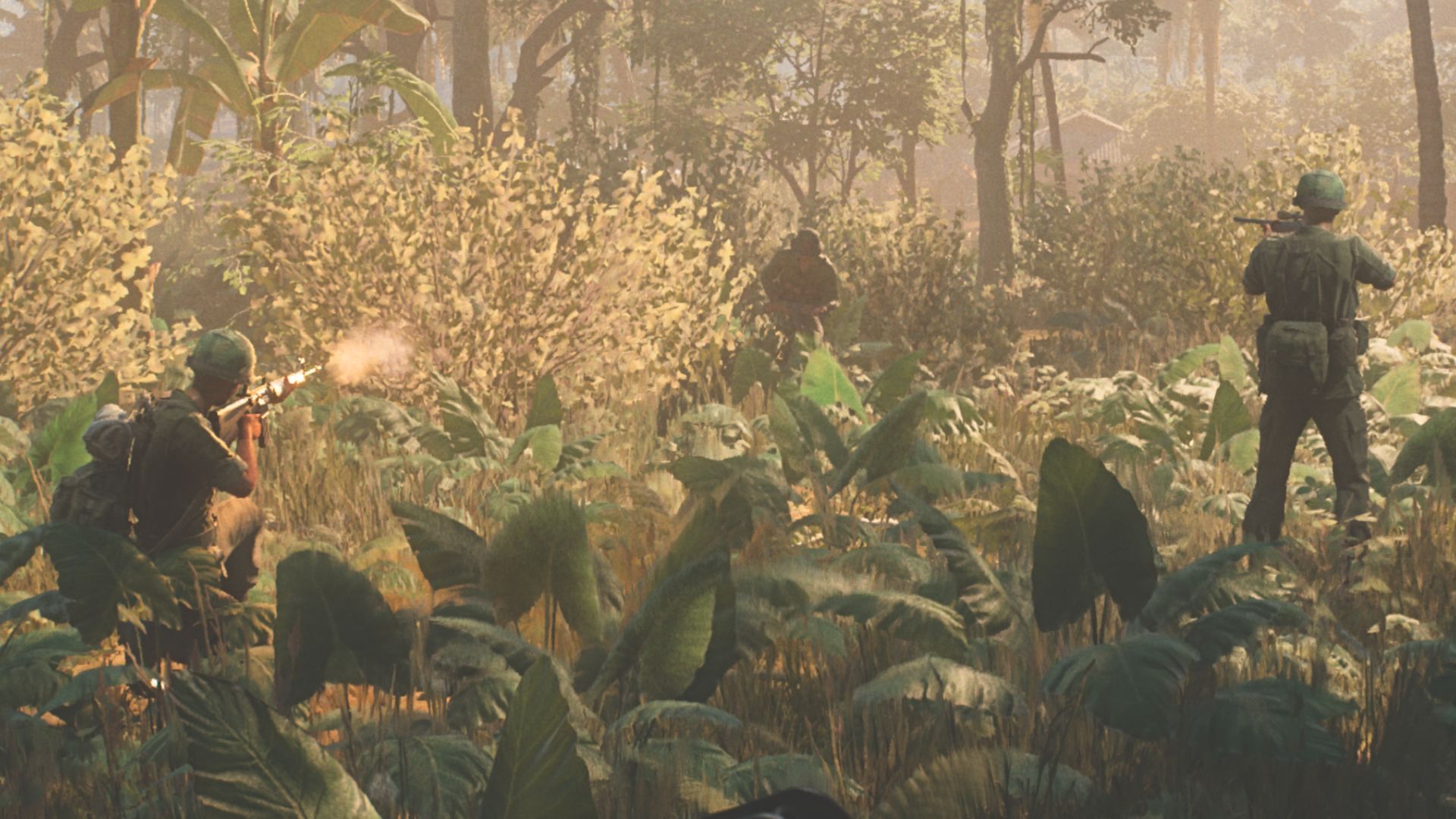
Ditching Europe for Southeast Asia, Hell Let Loose: Vietnam takes on one of the most divisive conflicts of recent times: the Vietnam War. Notable on an aesthetic level for its dense jungle, unforgiving weather, and too-close-for-comfort combat, it was morally questionable at best, and just so happened to be the first large-scale conflict to be televised to the masses. People saw everything for the first time in history, and were rightly horrified by what they saw.
The scene is set for HLL:V. We’re knee-deep in dense vegetation, with only a vague idea of where the enemy is; it’s chaotic and unforgiving. A far cry from the defined front lines of World War 2, this is a level of unknown that never really leaves you, with threats lurking everywhere, no matter what side you’re on.

The most common game mode is Warfare, a tug-of-war-style match in which both sides fight over a central point, advancing towards the enemy home base with each small victory. The to-and-fro of Warfare captures what Hell Let Loose is trying to be; my team’s attacks always come with the worry that overcommitting leaves our base ripe for the taking, with a failure on the pointy end of the stick knocking the entire team back a peg.
Hell Let Loose is an FPS game that most definitely teeters on the side of milsim. Single shots can be lethal, movement is slow and deliberate, and going it alone very rarely works out. Communication is almost as important as being able to shoot straight, with teams being filtered into squads and a commander figure overseeing the lot.
Infantry make up the bulk of the army, but there are also squads made up of armor, mortar teams, recon pairs, and even pilots; specialist roles that can give you the edge in a fight. The leaders of these squads have access to the team voice channel, and to be effective, they have to relay orders from the commander and pass on vital information from the wider team.

Delineating this chatter is a lot more important than I would have thought, and having a good squad leader makes all the difference when it comes to the efficacy of me and mine. Rushing blindly into the battle very rarely works, but having someone inform you of potential enemy positions and deciding on the next course of action often meant success.
Having the tools to do my job properly on the battlefield is largely out of my hands, and this is where I rubbed up against HLL:V a little. A lot has to fall into place for this hierarchy of experience and sound judgement to be effective – a commander who doesn’t quite know what they’re doing, or a squad leader that doesn’t want to talk, is a confusing nightmare.
It works both ways, too. A squad that has a couple of hotheads will automatically be less effective than one that sticks together. This is a game that demands teamwork at a minimum, and while the Hell Let Loose veterans already know this, the swathe of new players that enter the jungle might not, and I feel like the quality will suffer for that.

It’s tough, because it isn’t a new player’s fault for not wanting to immediately take orders from someone they don’t know. It’s a game; it’s supposed to be fun, after all. Running off alone, Rambo style, and getting a few kills might feel great in the moment, but it won’t win you the match. It sounds boring to be like, ‘just play as a team, you’ll really enjoy it, honestly,’ but that’s the message here. The more you put into Hell Let Loose Vietnam, the more you get out of it.
It’s a deeply satisfying experience for those who are willing to commit, but that means it can be frustrating when things aren’t quite going to plan. Not knowing what to do or where to go can be common in a match for the unfamiliar, and because of the nature of Vietnam, there isn’t always a landmark in the distance to aim for or a distinct area of fighting to gravitate to.
This chaotic lack of direction is, really, a testament to the work Expression Games has put into the look and feel of Vietnam. The jungle is claustrophobic; the soundscape is perhaps more so. Dense vegetation reduces visibility to near zero in its thickest parts, and crawling through brush was always a tense affair – an enemy could be meters away without me knowing it.

Twigs snap, insects buzz in my ear, and there’s always the ratatat of a nearby gun going off in the distance. I can almost feel the humidity radiating from my screen. This is about as far away from the war-torn streets of Carantan as you can get, but it feels just as authentic. Helicopters fly overhead, and depending on the side I’m playing on at the time, this fills me with hope or dread.
I eventually had a great time with Hell Let Loose Vietnam; once the basics had settled and I found my place in the team, it was a brilliant exercise in executing a plan. Mileage will vary, of course, and I expect a lot of people to struggle with the initial learning curve. The look of HLL will draw a lot to its doorstep, and I really hope that they stick around to appreciate what it is and what they can achieve in it.