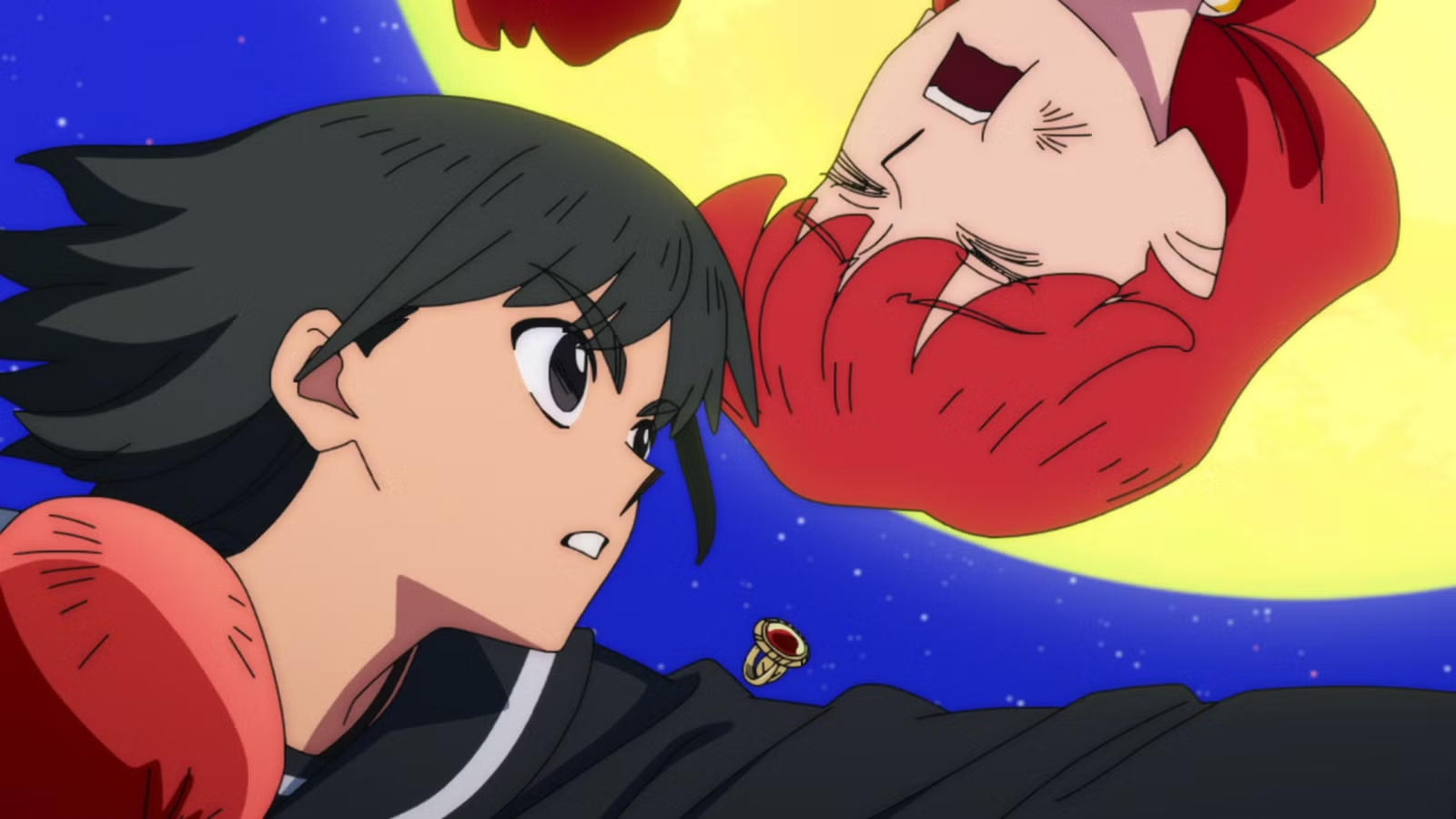
There’s a particular feeling I get when I watch certain older anime that is difficult to explain until I see them again. I can pause any moment in Vampire Hunter D: Bloodlust or Witch Hunter Robin and feel like I’m looking at an illustration rather than a frame from an anime series. The image has enough personality, texture, and detail that it almost feels wrong to let it move.
That feeling is why Goodbye, Lara grabbed my attention almost immediately. The series, which debuted on July 6 and continues to air weekly on Crunchyroll, takes Hans Christian Andersen’s The Little Mermaid and, like Frieren: Beyond Journey’s End, asks what happens after the fairy tale is long over. Lara falls in love with a human prince, fails to find the “true love” required to save herself, and disappears into the sea. Two hundred years later, she is resurrected in Japan’s Lake Biwa and given another chance to figure out what love actually means.

Director Takushi Koide has said in previous interviews that he wanted to take the globally recognizable idea of The Little Mermaid and crash it into something intensely local: Shiga Prefecture and Lake Biwa, the place where he grew up. Koide, who came up under Kunihiko Ikuhara and worked on series like Yuri Kuma Arashi and Revue Starlight, was particularly well-versed in the kind of fairy-tale and folklore structuring that Goodbye, Lara called for. That lineage makes him well-suited to dismantle and rebuild a classic story.
The same philosophy extends directly to the art of the series. Goodbye, Lara is constructed in such a way that it resembles older anime productions; most of the series is digitally drawn. There’s no need to pretend otherwise, or to argue that modern digital animation is somehow inherently lesser. But there is something about the way Koide and the team at Kinema Citrus approach the images that makes the series feel tactile in a way a lot of contemporary anime simply doesn’t.
It looks and feels drawn. You can see it in the thick outlines around Lara, the saturated colors, and the way the series frames its characters against huge expanses of water and sky. Lara’s bright red hair and clothes pop against the deep blues of the underwater world. When she emerges into the night above Lake Biwa, the yellow moon and dark water make the scene look less like a conventional TV-anime establishing shot and more like someone painted a storybook illustration and gave it motion.

The animation itself is often just as deliberate. Underwater, Lara’s hair and fins are constantly in motion with the currents, while seaweed and other elements drift around her. Even small details, like floating shards of a broken mirror and Lara’s tears moving through the water, are given motion. The world doesn’t simply exist behind Lara; it moves with her.
When the series really wants to show off, it does so through movement rather than spectacle. For a boxing sequence in Episode 3, Koide said that animator Hidehiko Sawada handled almost the entire scene, using “a ton of drawings” rather than relying on camera tricks or still frames. The result is deliberately raw and physical. You can feel the individual movements rather than simply register that the characters are moving quickly.
There’s a difference between animation that is technically impressive and animation that feels alive. It’s also why I’m hesitant to simply call Goodbye, Lara “old-school” or “hand-drawn.” Most of the series is digitally animated, even as its visual language deliberately evokes the tactile quality of older anime. But setting aside the strict definitions of the medium — whether a frame is built with ink and paint or a stylus and a tablet — the core truth is that the series clearly cares about the qualities we associate with traditional animation. It’s a subtle but important pivot: The magic isn’t in the specific technology used, but in the undeniable presence of the hand behind it. Koide himself described the production as something the team wanted to create “by hand,” emphasizing that they weren’t really using 3DCG or AI.

The opening sequence makes this distinction particularly fascinating. While most of Goodbye, Lara is digitally drawn, the spectacular opening incorporates actual analog cel animation into the sequence. It’s not the entire series suddenly reverting to a production method from decades ago. Instead, those cel-animated moments sit alongside digital work, their softer, more tactile texture briefly changing the feeling of the image.
Somehow, that makes the point better. Goodbye, Lara doesn’t need to recreate the production process of Bloodlust or Witch Hunter Robin to remind us why we loved those shows. Here, Koide emphasizes the subtle yet necessary vibe that every moment is a work of art. An old fairy tale becomes a story about modern Japan. A visual language associated with classic anime is rebuilt with contemporary digital tools. And traditional cel animation appears in the opening not as a replacement for digital production, but as another texture in the visual vocabulary.
When I interviewed Yoshitaka Amano recently, he and his collaborators talked about how traditional hand-drawn animation might actually feel new to younger audiences precisely because they have grown up surrounded by digital imagery. Amano’s team made a similar point about their upcoming project ZAN: digital tools aren’t necessarily the problem. The important thing is that the image begins with a human hand rather than being generated by the technology itself.

I think Goodbye, Lara demonstrates the same idea from a different direction. Maybe audiences aren’t asking for cel animation to come back, but are asking for animation that feels like somebody truly cares about every frame. That’s what I recognize in Goodbye, Lara. It doesn’t recreate the anime of my childhood, and I don’t want it to. Instead, it reminds me why those shows have left such a lasting impression. You could freeze any moment and see the artist’s hand right there on the screen.
Goodbye, Lara takes an old myth, draws it with a distinctly contemporary hand, and makes it feel as refreshing and memorable as some of the all-time greats.
Goodbye, Lara is streaming on Crunchyroll