

European game rating agency PEGI has begun increasing its age ratings for games that contain “paid random items,” a process that’s seeing games initially rated as low as PEGI 3—suitable for all age groups—bounced directly to PEGI 16.
Word of the change came from Connor Hindle, policy manager of the UK’s Games Rating Authority. “Since June, newly submitted games have been assessed against an expanded set of criteria within the PEGI rating framework, including new criteria relating to interactive risks,” Hindle wrote on LinkedIn (via GamesIndustry). “As the UK administrator of PEGI, the Games Rating Authority has now begun applying these updated criteria to selected existing digital products.”
These changes were announced in March, and are part of PEGI’s new “interactive risk categories” that include “purchases of in-game content, paid random items, communication features, and features that incentivise players to continue playing.” The new categories reflect the ways we view videogames have changed: While rating systems like PEGI and ESRB were initially created over concerns about violence and sex in videogames, the real dangers turned out to be much more insidious.
Latest Videos FromPC Gamer
As a result, any game with loot boxes is now rated PEGI 16 by default, and that’s led to some serious upjumps: EA Sports FC 25, for instance, is rated PEGI 3, as are previous games in the series, but FC 27 is PEGI 16: The former game has “no rating issues,” but the newer one has a detailed breakdown of the various purchase options on offer, including FC points, a season pass, and player packs.
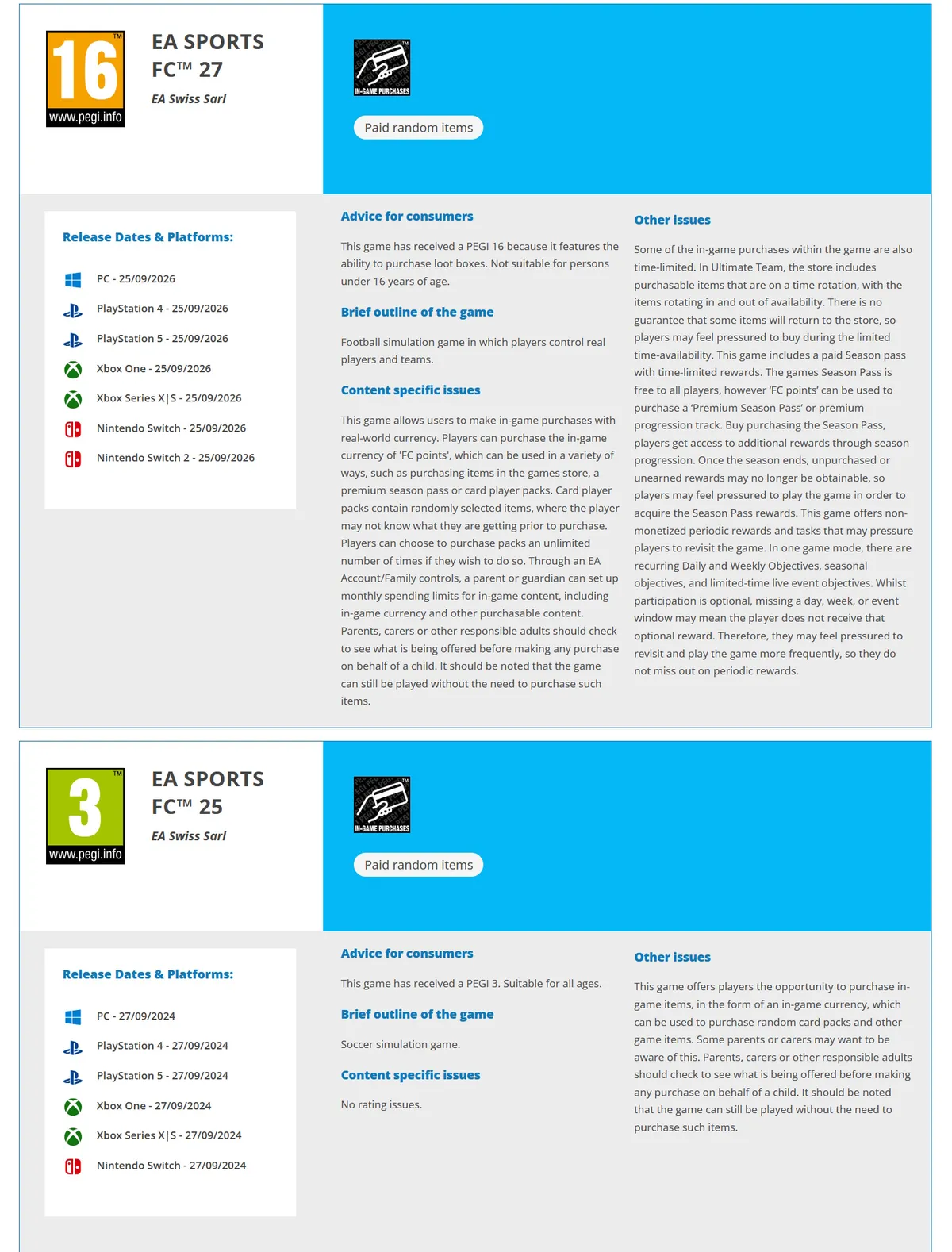
While PEGI is dropping the rating hammer on loot boxes and other in-game purchases, North America’s ESRB has indicated that it will not follow the lead: An ESRB rep said in March that its research indicated that adding “non-content related features” to its rating process could be confusing for parents. EA Sports FC 27 is rated E (Everyone) by the ESRB, with a note that it offers user interactions and in-game purchases.