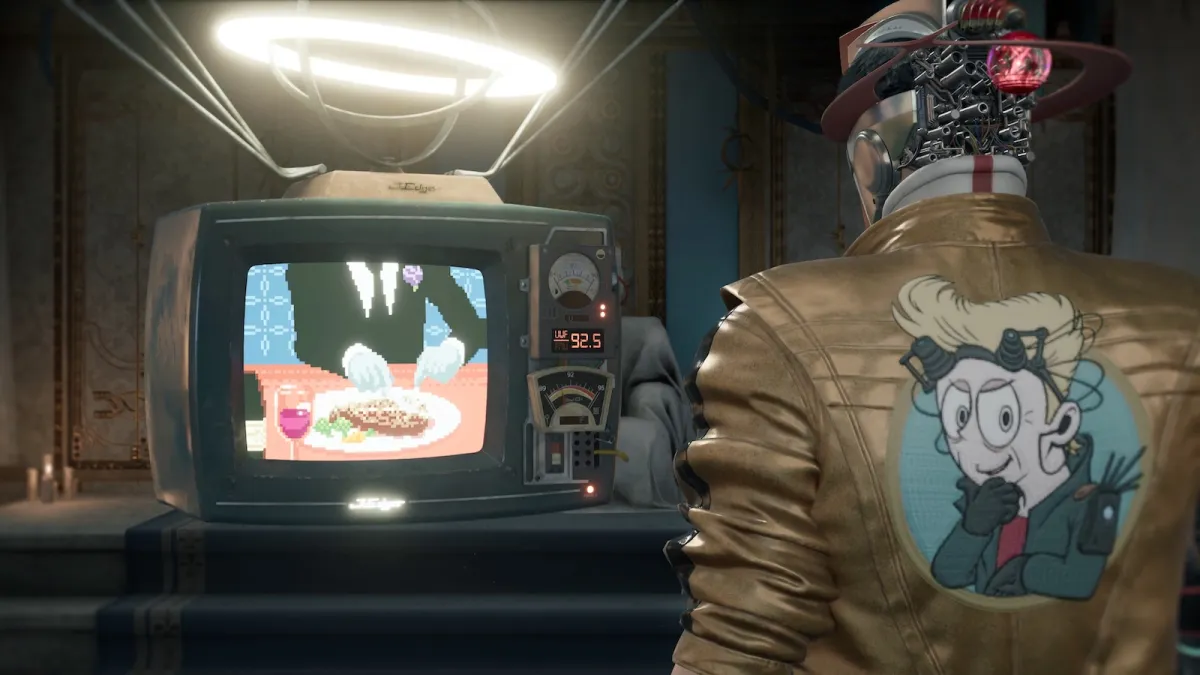
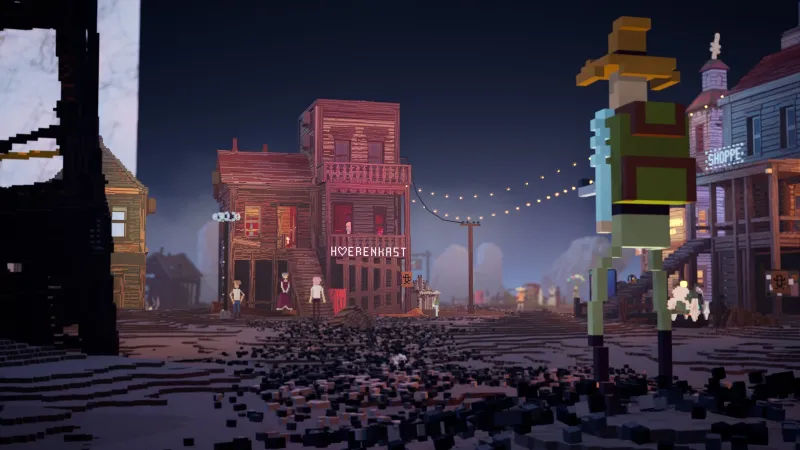
Erosion was one of the most promising upcoming titles I checked out during Summer Game Fest. Developed by a small team at Plot Twist (makers of The Last Case of Benedict Fox), the voxel-based game stars a nameless cowboy on a mission to rescue his kidnapped daughter; the twist is that time advances 10 years every time the father dies, meaning his daughter grows older.
Sporting a blend of twin-stick shooting, dozens of wacky weapon upgrades and abilities, dungeon crawling, and a highly reactive open world that changes based on your actions, Erosion is full of ambition. We spoke with Plot Twist creative director Bartłomiej Lesiakowski to better understand Erosion’s reactive nature, how the passage of time affects the world and players’ strategies, the game’s thematic inspirations, and its philosophy for creating consistently entertaining combat.
Game Informer: How long has Erosion been in development, and what inspired the idea?
Bartłomiej Lesiakowski: We’re in our second year of development, and the idea actually came from a story. We thought of the story, and since a lot of guys on our team are actually young dads, so the story resonated quite well from the get-go. And we were tinkering with it, and simultaneously, me and my buddy, who is the concept artist in Plot Twist, we also experimented with voxels as an art style, so those two things jump quite well, and given the story, it came kind of naturally that the game also became a role, right?
Erosion almost feels like almost like two different games, because you have the twin-stick shooting and almost roguelike structure with the abilities that you can gain, on top of the progression of the main plot of rescuing your daughter and having her age every time you fail. How did that particular mechanic come to life?
Lesiakowski: The technology of voxels and the approach that we took with it allows us to create assets extremely, extremely quickly for such a small team, so we wanted to flex a bit. And we thought that, ‘Hey, this could be our strength in this project, so let’s think about how we could use it.’ So we can destroy things, that’s one, so the combat should revolve around that. And by saving the daughter and going into the dungeons, we will surely die, right? So, what could we do to make the deaths meaningful? So let’s join those two things together. So, if we die, let the daughter age, and also when we die, let the world change, and by following this path, we basically created the whole concept.
For the daughter’s aging, how far does that system go? How old can she get? Is it possible for her to pass away from old age? And if so, what happens?
Lesiakowski: We don’t want to spoil too much, but let me say that there is a chance we won’t be able to even meet her.
I assume there are different endings, and if so, are the endings tied to when you’re able to rescue her, or what age she happens to be at the time that you rescue her? Does that affect how the game concludes?
Lesiakowski: The true ending for the story is one ending, but due to how the world is constructed, the timelines and the questlines themselves, as you recall, can veer off completely differently, so [the] story of each location in each variant can end quite differently.

How feasible is it to only focus on rescuing your daughter? I was talking to a rep at the event, and they kind of implied that, technically, everything else in the world is sort of optional in an almost Breath of the Wild way. If I wanted to try to only focus on rescuing her, could I do that with whatever my starting equipment is? And has anyone on the team been able to pull that off, if it is possible to do that?
Lesiakowski: It is possible. The world is technically optional, but this would be a challenge for some hardcore players. Right now we’re still in the balancing act, so there’s no chance to do that, but we are sure – and we, by the way, see it already in our telemetry from the playtest that has just begun that the players are already better at the game than we are, so I wouldn’t be surprised if somebody else would manage to do it.
How big is the world overall? What is the scope of this game, if you had to describe it?
Lesiakowski: That’s always a pretty tough question, because one thing is the geographical size, and the world, for what the game is, is pretty vast, actually. And the other side is that it’s also multiplied through every timeline, so it’s this certain amount of geographical space times X, basically. So this is why Erosion is so hard to measure in the traditional terms. I think that players will be surprised how much of a game is there, apart [from] the dungeons.
I was also shown during the demo a timeline that you can pull up, where you can see not only what you decided to do but all the possible outcomes. Can you explain how that works exactly? Because I believe the demo implied that you can jump between eras sometimes, but I wasn’t totally clear on how that worked exactly.
Lesiakowski: Yes, yes, exactly. So by playing, players naturally do certain actions, and whenever [the] game recognizes an action that actually will influence the future, they have a prompt, and players can check the timeline view to see what action caused the effect. And only after they will jump to the next timeline and explore the location, they will see what action caused what effect. So in the end, they will be able to see which resolutions for a quest can result in different outcomes for certain locations, so this will mean that in the end the players will be able to strategize, as well, because as you saw, also the new states of locations are connected to weapon and item unlocks, so they will be able to figure out what path they want to take, and later on they will just have to decide whether they are morally inclined to to follow the path as well.

So if I do a mission a certain way, can I immediately go back in time and do that same mission a different way, just to see the other way it could have gone?
Lesiakowski: Not immediately. There is some form of time control in our mind, but we also don’t want to give too many details about that.
Does time only advance when you die, or is it advancing slowly? Like, if I go a long time without dying, I don’t have to die just to see the outcome of everything I’ve done?
Lesiakowski: It still revolves around the specific timelines, as we call them. So the player either has to die three times, which we call the trice […] or they can initiate the jump manually.
What fascinates me about Erosion is that time plays such a big part and that it’s thematically a western. I don’t know why; I love that this is specifically a western story. Why is it a western? Was there any specific Western media that the team was inspired by?
Lesiakowski: That’s a good question. Actually, when I tried to backtrack the idea for the Western itself, I remember a point when we threw around a few references, and the idea that, in the first biome, the pillar will be surrounded by the desert, was from the get go, and we did want to have the setting be reminiscent of United States type of deserts and wastelands, and so on. So it kind of naturally veered into the cowboy and western setting. But the mix actually came from, I think, one of our biggest inspirations, the Adventure Time cartoon, which we absolutely love, and there are so many wacky and different and unique things about it. So we also wanted to create something with our twist on it, so there will be cowboys, but there will also be ghosts and robots and aliens, and you name it.
I noticed when I was jumped to like a save state where my loadout was a lot more impressive I had laser beams and drones and all kinds of stuff. I saw that you are touting over 100 different abilities and weapons and a crazy amount of combinations. Are you still creating more weapons and abilities? Is there such a thing as having too much in this game, or are you just shooting for the stars and making however many you can come up with?
Lesiakowski: Surely there is a limit, but it’s far, far off on the horizon. We’re so far from the limit, I think, so we are still creating, and we are still finding the technical limits, I guess. And also exploring the possibilities is just so much fun that probably till the very last moment […] we will add more and more items and weapons.

What’s the rule for adding a new weapon or ability? Is there such a thing as an idea being too stupid or outlandish for this game?
Lesiakowski: Too stupid or outlandish? No [laughs]. Maybe sometimes we tend to over-complicate solutions, so we have to have [a] few rules that we impose on ourselves like ‘Okay, this item can do only those two or three things at once. If you want more, let’s figure out another item that will be also interesting that can have this kind of ability attached to it.’ So in terms of weapons and modifiers, we started with [a] basic pool of items that will have a very classic roguelike gameplay controls, and after certain points, when we were sure that the basis is solid enough, now was the time to start creating the synergies. So, whenever we add now, first we identify the items that will have the most amount of synergies with existing items, and then we have like a crazy, crazy huge graph with the synergies, and we identify, ‘Okay, these types of builds are lacking right now, so what can we do? Can we create a weapon? Can we create a active skill, or passive modifier that will help improve the synergies in that region,’ for example. And all in all, of course, the fun is the main factor. So it has to be fun, and we remove the most passive and the most boring combination.
Are there any other major factions, like in the vein of the cultists I ran into in the demo?
Lesiakowski: Oh yeah. Dozens, actually.
How far does the faction gameplay go? Is it going to be a thing where if you side with one, you can’t side with another if they’re directly feuding? Can you change allegiances at will, or even join multiple factions at the same time?
Lesiakowski: Not at will, and depending on how the quests go, sometimes you create enemies for good, for example. But if your reputation with certain factions goes bad, because, for example, they caught you cheating at the poker table, there are also ways to regain reputation by, for example, questing for the opposite faction, like killing the opposite faction, or doing the quest for the faction that you lost some reputations with. So there is some room to play, and there will be certain factions that start with negative reputation, and it will be very, very hard, but not impossible to at least get neutral with them.
How do you communicate your current reputation? Is it something visible, like a meter, or is it more just the way people react to you that communicates, ‘Oh, they don’t like me.’
Lesiakowski: That’s something we’re actually still experimenting with. We have both solutions ready, and during different testing sessions, we try some stuff out, and we are still not sure, because certainly, to some players, it’s super cool to explore, to guess, and to experiment on their own. But certain players like to strategize and want to see exactly what they do, so we have to play a bit more with both solutions, and I’m sure we will pick the most fun one.

Who kidnapped the daughter, anyway? I don’t think I got a sense of who the main villain is in this game.
Lesiakowski: You need to play the playtest because the Summer Game Fest [demo], the game didn’t have the prologue, and the latest version already does, and there you will learn a bit more about the lieutenant and his henchmen; so the evil bunch, the daughter. But in the full game, the player will get to know a lot about them through the gameplay, especially through the dungeons, because they will play a big role in the overall story.
Does the protagonist have a name? Is there any sort of background that you can give me on him?
Lesiakowski: He’s just Pop.
Just Pop?
Lesiakowski: Just Pop for his daughter.
Was there any Clint Eastwood inspiration here, like in The Good, the Bad, and the Ugly, where he’s also a nameless outlaw?
Lesiakowski: For sure, he’s like a stoic demeanor, and he’s not talkative, that’s for sure. But we’ll leave it to the players to find if he says anything at all, or if he will be like the quiet protagonist for the whole time.
How big is the team exactly?
Lesiakowski: There’s 30 people at the studio, but we are currently creating two games. One is Erosion, and one is unannounced, and the Erosion team at the moment is 17 people.
Because of just how ambitious it sounds, is this the biggest game that you’ve ever tackled in your career?
Lesiakowski: Yeah. We tend to dabble in ambitious projects. We constantly like to remind ourselves that, ‘Yeah, maybe next time the next game will be simpler,’ and we always end up with something more and more ambitious.

What would you say has been the most challenging aspect of developing Erosion so far for you?
Lesiakowski: There are so many unique aspects to the game that probably the hardest part is not having like clear references for many things. There are here and there parts that we can figure out based on what other people did, but in most cases we end up in a tough spot, because some aspects of the game are too different from everything there was, so we just have to figure it out and playtest as much as we can, and follow the fun, basically, and see what is most attractive to the players. And previously, probably in our previous project, when we were creating a metroidvania with a surprising amount of puzzle elements, it was slightly easier, so I think this is the most challenging part with Erosion.
On the flip side, what’s been the most enjoyable aspect of developing the game so far?
Lesiakowski: Both the aspect of working with voxels, especially with our approach, and with how many steps that usually are needed to create assets for the game, the development is very agile. So we can figure out the character, basically like creating it from Lego, and few hours later it’s already an animated character in the game. So it’s a very freeing feeling to have as a developer, that it doesn’t have to follow all of the steps that usually are connected to creating assets.
And the second thing is that we put so much time into make sure that the base and the moment-to-moment gameplay is enjoyable, that the testing itself is also enjoyable as an effect. I remember when we started implementing destruction, and there was almost no possibility to open the game and not destroy something just for the sake of destroying, just to have some fun, to see the voxels spread around. It’s a very rewarding feeling.
Last question: What’s your favorite Adventure Time episode?
Lesiakowski: The hardest question is the last one. Maybe [“Jake the Brick”]? When Jake became a brick. It’s such a cozy and out-of-the-box idea. Probably this one, yeah.
Erosion launches in 2027 for PlayStation 5, Xbox Series X/S, and PC.