
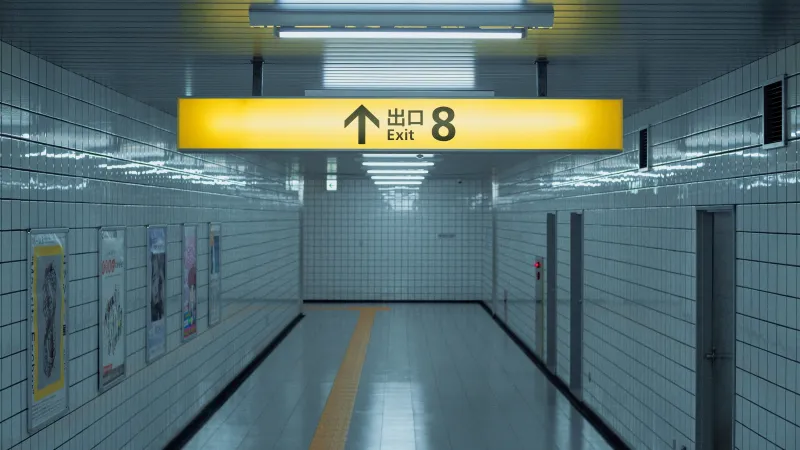
In November 2023, developer Kotake Create lured unsuspecting players into its unassuming but deeply unsettling horror game, The Exit 8. The first-person game traps players in a realistically rendered looping hallway of an empty Japanese subway station, and tasks them with studying their sparse surroundings to spot visual discrepancies, called “anomalies”. Correctly identifying anomalies, which can be easy to miss, like an overhead sign reading “Turn back turn back turn back,” or more blatantly scary, like a locked closet door suddenly creaking open, allows players to progress to the next loop, starting from Exit 0 and ending at Exit 8. Failing to identify an anomaly before completing a loop resets the player to Exit 0.
The Exit 8 became a well-received cult hit and has now been adapted into a live-action film. Premiering at the Cannes Film Festival 2025, Exit 8 was released in Japan last August and is set to premiere in US theaters this Friday, April 10 (courtesy of Neon, distributor of other foreign hits like Parasite and Portrait of a Lady on Fire). After watching Exit 8, we spoke with its director, writer, and producer, Genki Kawamura, to learn what he finds so fascinating about the game, how he approached adding an original story, and the surprising advice he received from Mario creator Shigeru Miyamoto.
Note: This interview contains light spoilers for Exit 8.

The Exit 8
Game Informer: How did you first learn about The Exit 8? Have you played the game, and what do you think makes it an interesting horror experience?
Genki Kawamura (speaking through a translator): When this game first went on sale, I played it almost immediately, and I was amazed by the game design, the very simple rules of the game, as well as the sort of visual expression that the game had in itself. The one thing it didn’t have, in the game version of it, is, of course, a story, which I actually thought was the perfect opportunity for me to come in.
Was the lack of story the main appeal for why you thought it would make a good film?
Kawamura: So, in terms of this game’s appeal, I actually recall a talk that I had with Shigeru Miyamoto 10 years ago, and in one of his talks, he said that a really great game is not only fun for the players but also the people viewing the player playing the game. And that essence is what we wanted to capture with this film. So at times, the audience is in the shoes of the player, and at times it’s almost as though they’re watching a livestream. And this dynamic and relationship, in and of itself, is almost kind of a reflection of the video game industry at large. And that was one thing I was very adamant about. I didn’t want to make a film adaptation of a video game. It was very important to me that we were blurring the lines between what is video game medium and what is a film medium, and in doing so, I think we created this very new film experience.
That’s interesting because I think one of the things that impresses me about the film is how faithful it is to the game, down to just how accurate the hallway looks, and even how the first sequence is almost entirely in first person. How closely did you work with the game’s developer, Kotake Create, on the project?
Kawamura: I was working with Kotake Create very early on, from the screenplay, the writing stage, if you will. We worked very closely for the story component, and in terms of the visual expression, the production design team in Japan did an amazing job. We wanted to recreate that corridor and the visual expression that had almost as though it was rendered through Unreal Engine, but do it using only practical effects. So from the tiles to that glossy texture and effect you see on the floor, that was all done practically, but it was done in a way as if it was rendered through a game engine. And the same goes for the talent, the actors as well. The direction was to act as though they were characters in CG or kind of like a video game, but we want to do that with live-action actors, and we figured [out] how to recreate that, that eeriness. But I think it’s that blend of recreating what seems like it should be a video game using live-action mediums and techniques that gives it that overall, very kind of creepy, eerie feel.

Genki Kawamura
So, just to clarify, that hallway is a physical set piece?
Kawamura: Yes, the corridors that you see in the film were all built using practical, physical sets. And the other gimmick that made a lot of what we shot possible was the fact that we built two identical corridors, and it was almost a copy and paste of these physical sets, but that allowed us to create that looping effect using single shot, or shot that kind of would blur the edit, so you couldn’t even tell where one corridor begins and where the next one ends. And I think that really helped us in terms of blurring the cut point, but also immersing the people, the audience, into that world.
Yeah, I think the cinematography, especially, I was impressed with because I think a lot of the way the camera moves, and the way it directs your eyes, manages to emulate playing the game in first person and capturing what makes the game scary; things appearing in your peripheral, or you turn a corner, and something is suddenly there. You mentioned before not necessarily wanting to do just a film adaptation of a video game, but at the same time, a lot of those techniques are very evocative of the game. Were you conscious of trying to capture the way the player moves in the game?
Kawamura: Certainly, the opening shots where we go into first-person [point of view], we took almost this daily routine going through the subway and filming it in a way that felt like you were in a video game. But once you entered the corridor, then we switched to [a] third-person point of view, and all the Exit 8 scenes are now viewed from the third-person. So we almost flipped your sort of daily routine and put it into a video game type of perspective, and what you would expect to find in [a] video game in a third-person kind of perspective. And when shooting the first-person POV shots, I had told the camera operator that it should feel like a video game; the motion, the way the camera turns, etc. And one other element is the corridor itself. We wanted the corridor to feel like a character in the film. And the yellow sign that you constantly see over and over again is almost like this divine creature, God overseeing the corridor. It’s, in a way, my own throwback to 2001: A Space Odyssey, how HAL becomes this very, very creepy character in the film, in the same way we wanted the Exit 8 sign to have that equal level of divinity, but creepiness.
You mentioned that The Exit 8, the game, is kind of devoid of an actual storyline. So it’s a blank canvas to tell any story that you want to tell in it. What inspired the story of this game and the themes of parenthood and a fear of responsibility? What inspired the story of the protagonist?
Kawamura: The video game to movie adaptation, I think, in and of itself, is somewhat cutting edge in that respect. But while being a very cutting-edge type of adaptation, I lean heavily on classic horror films and that classic horror storytelling structure, referencing Stanley Kubrick and The Shining or director [Kenji] Mizoguchi and his film Ugetsu, where they both kind of explore this idea of someone falling apart and the process of fatherhood. And I think for a video game source material to go into the Cannes Film Festival, we definitely relied a lot on that sort of classic movie structure, but also this new idea, the way we adapted it. And when I did go to Cannes, people also mentioned, I think it’s the first time that a video game source material movie even made it into this festival. So I think that was kind of a very important point in the overall sort of structure and position of this film in its context.

One of the things that surprised me was that there’s an origin story for the walking man that you see just looping around. Why did you decide to focus on that character, who in the game is just another element of the hallway?
Kawamura: If you notice in the film, none of the characters have names, and in the way I wrote it, I positioned everyone as an NPC, if you will. And from the player’s perspective, when playing a video game, of course, all the other characters in the game appear as NPCs, but what if we switch the perspective to the NPC? What would happen? So going back to the train scene, and when I’m on a train myself, I feel like I’m the main character of whatever story this is that’s unfolding around me, vice versa, if I was in that person’s perspective, I would basically be an NPC or a mob, a character in that regard. So, taking that sort of idea of “What is an NPC?” from which perspective, I wanted to add a lot of humanity to that. So that’s why I really put the spotlight on the NPC and developed their story to kind of almost be a reflection to us, that we’re not also the main character, and I think that that was a very important turning point in the development of the screenplay, and really elevated it.
I’m curious, do you know how many laps the actor who played the Walking Man had to walk while filming this movie?
Kawamura: So I can’t even recall how many times I had him walk down the corridor. And the same goes for that very eerie smile, that video game NPC CG-like smile. I remember towards the end of filming, he said his muscles were twitching because of how he had to hold that smile for so long. But a lot of our filming methods were very, very analog, very practical. It was almost like being in a circus. For example, when the Walking Man would walk through the corridor, and I wanted the Walking Man to show up again so we get that effect of looping, after he walked through the corridor and we got him on the shot, the camera’s still rolling. He has to get on a bike, ride all the way to the beginning of the other side of the set, reset, hide the fact that he’s completely out of breath, and walk again. So a lot of what we were doing was very rooted in this sort of practical filming, analog filming, type of style. So a huge shout-out to the actor [Yamato Kochi], who did an amazing job as the Walking Man.
I can’t remember every anomaly from the game because it’s been years since I played it, but was every anomaly in the film taken straight from the game, or were there any that you guys created for the film? And were there any anomalies from the game that you wish you could have added, but couldn’t find a place for?
Kawamura: In the game, we, of course, looked at it, found the anomalies, and adapted a lot of those into the film. For example, the moving eyes in the poster, the doorknob in the middle of the door, which, to me, was very, very creepy, and one of my favorites of the anomalies. But when looking at this film, and when I was developing the story for it, I thought really long and hard about what the corridor is and what it represented, and I kept coming back to Dante’s Divine Comedy and this idea of purgatory. And in a way, I felt these anomalies were the manifestation of this guilt that we carry through our daily lives, projected onto the environment around us. So it’s almost like an inside-out effect. Things on the inner side of our minds are then projected outwards, and those, then, are turned into anomalies. And when I arrived at that sort of understanding and structure, then we developed some original anomalies for the movie itself as well. So I think it was a good mixture of drawing anomalies from the video game itself as well as coming up with originals based on this idea of purgatory and mixing them together.

What I also like about the movie is how it kind of expands the lore of how this purgatory, this hallway, works. At one point, you see more than one trapped character in the hallway at the same time, which is not something that happens in the game. Was that something that you guys brought to Kotake Creates to ask, “Hey, what if we had another person trapped, or two people trapped at the same time working together? Would that work in this universe?” Or did they give you guys some kind of lore guide explaining “Here’s how this world actually works,” even if it’s not all explicitly shown in the game? I’m just wondering who helped expand the rules of this universe.
Kawamura: It goes back to the original concepts of trying to blur the boundary between the video game and movie mediums. And the first-person components of the film, I think really kind of leans into that video game underlying source material. But also, I looked, when developing the screenplay, a lot at the streaming, the Twitch streaming and YouTube streaming culture, and specifically Exit 8 YouTube streams. And in doing so, I realized that there were as many stories as there were YouTube videos and content creators, and it really fascinated me that so many people can play the same game yet come up with so many different actions and reactions to what’s happening on screen in their video and in the film. Ultimately, what I was trying to do was really capture all of that and drop it into this experience.
That actually leads into another question I was going to ask. What I love about the film is how authentically the characters react. They react the way I felt playing the game in terms of their excitement when they would get an anomaly correct, and they would advance, and then the sheer frustration when they would reset the loop and everything in between. There are even bits where they almost become a little numb to seeing weird things, because now they’re just focused on trying to get through it. Did you draw upon your own personal feelings and experiences playing the game, or how much of it was influenced by watching so many other players and getting a range of reactions?
Kawamura: When I was playing the game for the very first time, I was actually playing with a group of friends, and I recall every time we would reset the corridor to zero, I’m getting mad at my friends too. It’s like, “Man, why aren’t you guys paying attention? There was an anomaly there!”, or vice versa, and that sort of stress that you experience from getting reset all the way back to zero is something I definitely reflected in the movie itself. And what I also found very interesting was how the story in the game was almost a reflection of our daily lives itself, where there are anomalies in our daily lives, and we either go about our lives noticing them or pretending not to notice them, or not even notice them at all. We can be swiping through social media feeds, we’ll see news of different violence or wars or any type of anomaly in the world, and what you do with that information, whether you act on it or ignore it, I think, is really something that I felt while developing the film. So I wanted to also capture that personal experience that I had in the movie.
Have you played The Exit 8’s sequel, Platform 8, and if so, what did you think of it? Do you have any interest in adapting that into a film?
Kawamura: I have played it, and I’m not confident that I can get out of that particular corridor, but I had a lot of fun.
Exit 8 will premiere in US theaters on April 10.