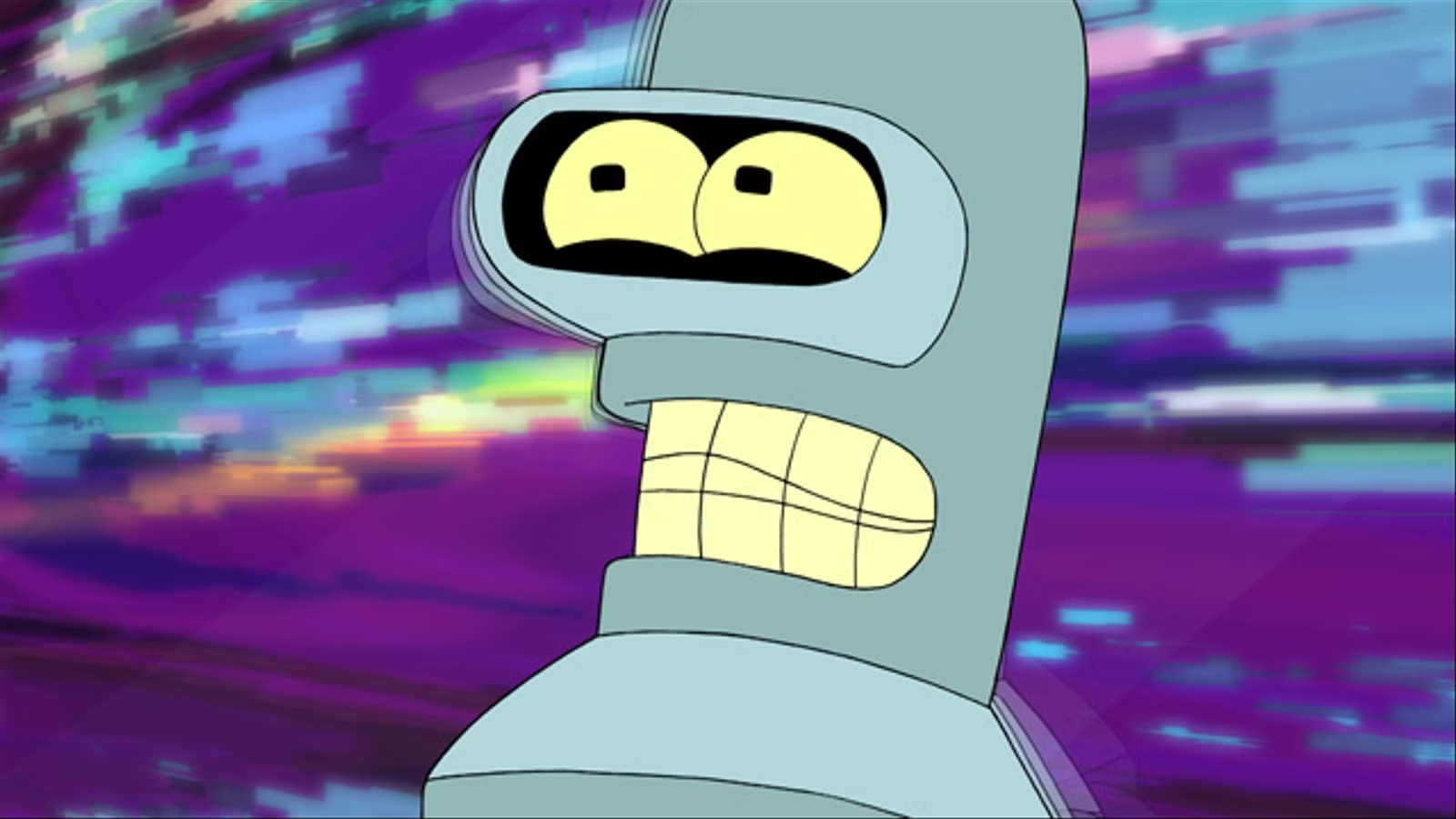
“One thing we take pride in at Futurama is that we have a lot of practice writing last episodes ever.”
When David X. Cohen sat down for an interview with Polygon last week, this is what he said about the show’s latest “last episode ever,” titled “Final Ending: The Last Conclusion.” However, despite the episode name, we already know that this is not the official ending of the series and that Futurama will release three animated specials sometime next year.
Still, “Final Ending: The Last Conclusion” was written as a potential series finale — the sixth such time in the show’s history that this has happened. But until we get yet another “last episode ever,” it’s worth ranking the finales we have thus far on the criteria of just how good of a finale they are (as opposed to how good the episode itself is).
6
“Overclockwise” (2011)

Futurama has four main eras. First there were the four seasons that aired on Fox, then there were four straight-to-DVD movies, then four seasons on Comedy Central, and finally, four seasons on Hulu. “Overclockwise” came towards the end of the second Comedy Central season, when it was unclear if any future seasons would be ordered. As a result, “Overclockwise” was written as a “just in case” season finale by Ken Keeler, who wrote several other episodes on this list.
“Overclockwise” is mostly a Bender (John DiMaggio) episode about Bender’s factory settings being overclocked by Cubert (Kath Soucie), causing Bender to become an omnipotent supercomputer. In response, Mom (Tress MacNeille) takes Professor Farnsworth (Billy West) to court for voiding his warranty on Bender. Meanwhile, Leela (Katey Sagal) is feeling restless in her relationship with Fry and she leaves the Planet Express company. She eventually returns and the episode ends with the two of them reading a report prepared by Bender when he was a god-like being, which tells the couple what their future holds.
Bender is my favorite character and this is a good story for him, but “Overclockwise” is easily the worst “series finale” because it doesn’t really feel like a finale at all. Futurama is Fry’s show first. He’s the hero and any finale has to put him front-and-center. While the moment with Fry and Leela learning about their future is touching, the main character can’t be relegated to a B-plot for the series finale.
5
“The Devil’s Hands Are Idle Playthings” (2003)

I can already hear the opposition to this episode being so low on this list, but please allow me to explain. Also written by Ken Keeler, “The Devil’s Hands Are Idle Playthings” is an excellent episode. I’d even say it’s the best episode on this whole list, but as a finale it’s only pretty good.
The episode is a touching story about Fry trying to learn a hologram-projecting musical instrument known as the holophonor in order to impress Leela. On Bender’s advice, Fry seeks help from the Robot Devil (Dan Castellaneta), who offers him a deal to trade hands with any robot in the world. By coincidence, the randomly-selected robot ends up being the Robot Devil himself, and the two switch hands.
Fry becomes an expert at the holophonor, and he writes an opera to impress Leela, but in the end, the Robot Devil gets his hands back and the episode ends with a sweet, crude hologram projection made by Fry’s earnest yet sub-par holophonor skills.

Most online Futurama sources say that this episode was intended to be a finale, but that’s not entirely correct. In the original DVD commentary of the episode, showrunner David X. Cohen said, “we thought there was probably a 50/50 chance [this was the final episode], so we kind of wanted to hedge our bets and not have everyone literally wave goodbye at the end, but to at least go out on a sweet note.”
The episode is incredibly sweet, but I’d argue you can feel that they were hedging their bets here. While Fry’s concert felt like a milestone memory for him and Leela, it didn’t feel like a conclusion of anything. As someone who watched Futurama from day one back in 1999, I remember seeing this episode live and feeling like it left me wanting more Futurama, not that the show had come to some satisfying conclusion.
4
“Otherwise” (2024)

“Otherwise” came at the end of the second Hulu season and it was written by Ken Keeler to, once again, hedge their bets with a maybe/maybe not ending as they didn’t know if Hulu was going to want more seasons.
Prior to this episode, it had been suggested in other episodes that the Planet Express crew we are watching may not always be the same versions of the characters. Instead, there is a vast Futurama multiverse and we may be seeing different versions of them at different times. This helped to explain away some of the show’s continuity errors over the years and felt like a high-concept wrap up, with a good chunk of its time dedicated to the events of other episodes. To be clear, it’s not a clip show, it just acknowledges a handful of other episodes, especially the previous finale, “Meanwhile,” which appears higher on this list.
While I know some of the bloom is off the rose for multiverse stories, I thought Futurama was especially adept at playing with these ideas and I appreciated some of the housekeeping involved, even if that made for an interesting concept with a so-so story. Also, the episode felt like it lived fully in the shadow of “Meanwhile” — even the title is kind of similar — because of that, it doesn’t really stand up on its own two feet.
3
“Final Ending: The Last Conclusion” (2026)

The most recent finale, written by Margot Pyrceman, is very good, so don’t misinterpret its placement here, either. Overall, the episode deals with a story about Fry seeing his first PG-13 movie with his brother back in the late 20th century. But, they are kicked out of the movie before the ending and now Fry really wants to know how it ended, so he’s on a journey to find what might be an entirely lost film. Meanwhile, the Professor puts forth a theory about how wanting to know the ending of stories is an evolutionary trait. Cohen explained this in his recent Polygon interview, when he said the following:
“It’s based on this idea I have that human beings actually evolved to need to know the ends of stories,” said Cohen. “The example I’ll give you is, hundreds of thousands of years ago, when early humans started telling stories, if someone started to tell a story about a forest, some of the people in the troop wanted to hear the rest of that sentence, and some didn’t care. Well, the ones who wanted to hear it could find out if there was a bear in the forest who was going to maul them to death, or if there was a tree that was covered with nutritious mangoes. So, I think that is an evolved need, like eating and breathing and reproduction, that humans have, to hear the end of stories.”
Aside from Fry and the Professor’s stories, a handful of other ending-related stories occur in the episode, which clearly relate to the “idea” of endings overall. There is also a significant nod to “Meanwhile” in this episode.
As opposed to the more emotional entries on this list, this is a more high-concept idea about finales, as much as it is a finale itself. As such, it’s not the most satisfying story in the world, which is also true of “Otherwise.” The main difference between the two is that multiverse shenanigans are something that we’ve seen in a lot of different sci-fi TV shows and movies, whereas Cohen’s musings on finales feels like an entirely original idea born out of having to do a whole bunch of series finales.
2
“Into the Wild Green Yonder” (2009)

“Into the Wild Green Yonder” was the last of the four direct-to-DVD Futurama movies. Also written by Ken Keeler, the episode saw Fry get tangled up in an ancient battle between two of the universe’s oldest races, the life-preserving Encyclopods and the life-destroying Dark Ones.
The thing to understand about Futurama’s direct-to-DVD era is that each of the four movies was designed to also be broken up into four regular-length TV episodes. As such, there are some structural issues with each of them, with odd act-breaks and some smaller stories which feel like they are only there to satisfy these demands. That said, I think Futurama is the rare TV show that could be scaled up to movie-length stories, as the show did small stories as well as big, end-of-the-universe kind of stories, too.
What I like about “Into the Wild Green Yonder” is that it feels big. It feels like the show could have ended here and while it may not have been the perfect finale, the scale of the story felt grand enough to conclude the series.
Fortunately, it was not the end, otherwise we would not have gotten the show’s best-ever “last episode ever.”
1
“Meanwhile” (2013)

“Meanwhile” is the best of Futurama all in one tight, 22-minute story. It has the heart of “The Devil’s Hands Are Idle Playthings,” the grandiosity of a Futurama movie, and a high-concept idea that keeps you thinking long afterwards.
After Leela has a near-death experience, Fry decides it’s time he proposes to her. Meanwhile, Professor Farnsworth invents a “Time Button” which allows a person to go back in time by ten seconds. The episode has a whole bunch of time travel shenanigans to it that are a lot of fun, but they end when Fry breaks the Professor’s invention, freezing time for everyone except he and Leela. The two then grow old together in a touching sequence with the two of them in a frozen world.
At the very end of the episode, the Professor arrives and explains that he’s been tunneling through time in search of the missing time button. He quickly repairs the button and explains that they’ll all return to the point just before the button broke, fixing everything, and causing Fry and Leela to revert to their younger selves, without even a memory of the frozen lifetime they spent together.
The episode is beautiful and poignant, while still being funny and Futurama-y thanks to the high-concept idea. It’s also the only finale that doesn’t seem at all like they are hedging their bets in hopes of a late renewal. While the Professor does end up undoing the events of the episode, he couldn’t erase the way it made us feel.
A decade later, Futurama did return, but “Meanwhile” was the one time where Futurama ended and it felt like, maybe, it should end. While I’ve enjoyed the show’s revival and look forward to next year’s episodes — including another finale — I honestly don’t think the show will ever be able to out-do “Meanwhile” and by the way the subsequent finales have acknowledged the episode, it seems the Futurama writers know it too.