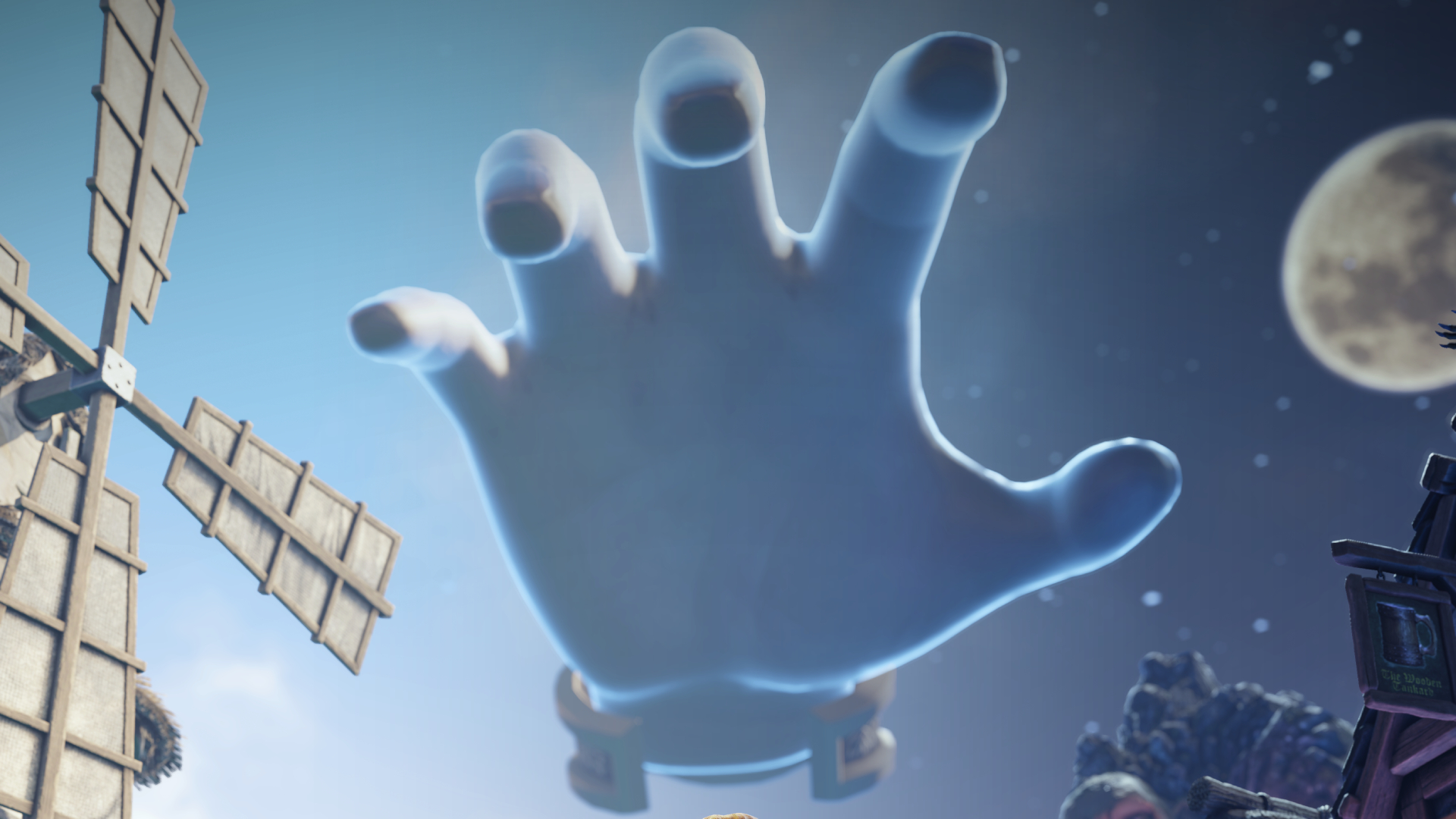
When I spoke to Fable creator and 22cans founder Peter Molyneux about Masters of Albion earlier this year, he told me that he simply wanted it to bring “joy.” It’s a word that resonated throughout our discussion: one that Molyneux is clearly passionate about. It’s been a rocky road for him, after all: post-Lionhead, things haven’t been easy. Unfortunately renowned for his tendency to “overpromise” and underdeliver – something he’s since apologized for profusely – there’s a lot riding on Masters of Albion. Reputationally, it could be the salve that Molyneux needs, but it could also mark the triumphant return of the god game – a genre that hasn’t really been well-served since the Black and White days. It’s a title that I’ve been excited about since its reveal – I’m a longtime Fable fan, and spent my youth tinkering with Black and White. My hopes, then, were high.
If you’re unfamiliar with Masters of Albion, it’s part god game, part strategy game, and part fantasy RPG. You’re tasked with fixing up a ye olde English town using your deity-esque magic and tactical skills. During the day, life happily ambles by: you wait for the trusty airship to arrive, fulfil whatever bulk order it asks you to complete, and train up your heroes to fend off the horrors, which largely means letting them chill in the hot spring. When night rolls around, however, your town is besieged by myriad undead beasties that are intent on getting to the golden door that lies at its center. If said glittering bastion falls to the shadows, the town dies, as do your hopes of reviving it.
While the nighttime gameplay is largely confined to your little hamlet, during the day you can take possession of your heroes and ride out into the world. Inspired by Dungeon Keeper, exploration and combat play out in the third person, just like your traditional RPG. The world is relatively small in scope, but there’s clear room for expansion. It’s a fun twist that I’m absolutely obsessed with, and it breaks up some of the monotony of simply watching your citizens rush around making things for hours on end.

I will say, however, that the combat systems and some of the building features are a little rough around the edges. I found it relatively difficult to land the perfect skeleton-squishing rock, as while gravity pulls them down hills in spectacular, Indiana Jones-esque style, the shadow that you effectively use as your place marker doesn’t always match up to where the rock drops.
It’s a similar story with your arcane abilities: my lightning bolts sometimes flew off to hit random structures instead of the enemy I was aiming at, and while you are informed that you can run out of mana, there’s no immediate way to track where your levels are at. More generally, the UI is relatively basic but largely inoffensive.
In terms of building, I found the fence system a little unwieldy, with posts sometimes heading off in unintended directions. This consistently left a hole in one of my barricades next to the town’s pond, but thankfully, it seemed like the enemies couldn’t move through water, and continued to simply run at the one section of fence World War Z-style.
When playing as the hero, combat isn’t exactly life-changing. You can level these characters up and unlock different perks, but there are no perfect parries and dodges here. That’s not really an issue for me – the central thrust of Masters of Albion’s combat comes from your creativity with the god hand – but if you were looking for robust, Witcher-esque combat, you won’t find it here.

What is here, however, is perhaps one of the most enjoyable town management systems I’ve seen in a while. While grain and flour pass through the pipeline as you’d expect, you can help your villages along by picking up bags and transporting them for them, or, alternatively, picking them up and transporting them instead.
In the factory, you’re tasked with creating your own recipes, ranked in terms of deliciousness. You then pitch these to some rather discerning critics, who decide whether or not your food is, in fact, palatable. What I enjoy, however, is that you’re not simply gifted a recipe and told to make it. Instead, you’re given hints as to what ingredients you’re expected to include. I’m asked to create something with “bread and dairy, nothing more,” which I correctly identify as being a cheese sandwich. My next meal has to use an ingredient that’s been sourced in an “alley.” That’ll be the dead rat, I presume.
Masters of Albion never tells you what to do outright. I’m tasked to solve a singing stone puzzle by aging hippie Jon Bovi (ha ha), to which he simply tells me that it’s all about that “do, re, mi,” a hint to the musical scale. It’s clever, it’s funny, and most importantly, it actually tests your brain cells a little bit – something that I feel games struggle to do these days.

That levity and sharp wit extends throughout the rest of the game. While the overarching campaign is relatively serious, the world itself exudes playful stillness, akin to the likes of Fable and Fable 2. The first thing I do when I spawn into the game is boot a chicken. As I wander out into the wilderness as my hero, I’m greeted by a stone gargoyle (or ‘grotesque’) hurling insults at me; presumably a throwback to the seemingly omnipresent Scottish statues that used to howl “hi, my name’s barn door – bet you cannae hit me!” Turns out this time I can, ya dobber – who’s the better Scot now?
Masters of Albion manages to achieve all of this without simply feeling like ‘Peter Molyneux’s greatest hits,’ however. Its inspirations are clear, and there are flickers of his previous work everywhere you look. But it’s not just a mindless chimera of ideas fused together to tug at your nostalgia: MoA is a fun experience that, while a little rough, stands strong on its own. Even those rough edges are forgivable – it’s early access, after all, things will continue to evolve. If nothing else, they give it a little bit more character.
I’ve spent hours with Masters of Albion. Its charm, quirkiness, and genuinely fun gameplay loop have etched themselves into my soul in the same way that Fable and Black and White did. It’s a breath of fresh, happy air in a videogame world that’s so obsessed with dark, 50-hour narratives and exploring real-world traumas. It’s playful, it’s silly: it’s joy.
With Masters of Albion, Molyneux and 22cans have achieved what they set out to do. Is it going to be a game for everyone? No, but that’s the nature of god games, and strategy games more broadly. Is it a game you should spend some time with, however? Yes, yes you should, if only for the rush of dopamine and the creative new insults you’ll learn along the way.
Masters of Albion is now available in early access form via Steam, priced at $24.99. It’s 10% off for launch week, bringing it down to $22.49 / £20.24, but you’ll need to grab it before Wednesday, April 29.