
A traditional adventure format seems an ill fit for something as freeform as Minecraft. The Markus ‘Notch’ Persson-created global phenomenon is an experience built on creativity with endless scope for experimentation, so constricting it within the boundaries of genre seems misguided. That said, the franchise has enough cultural pull that it drove audiences to brandish wild animals in movie theatres, so there is clear versatility in this IP.
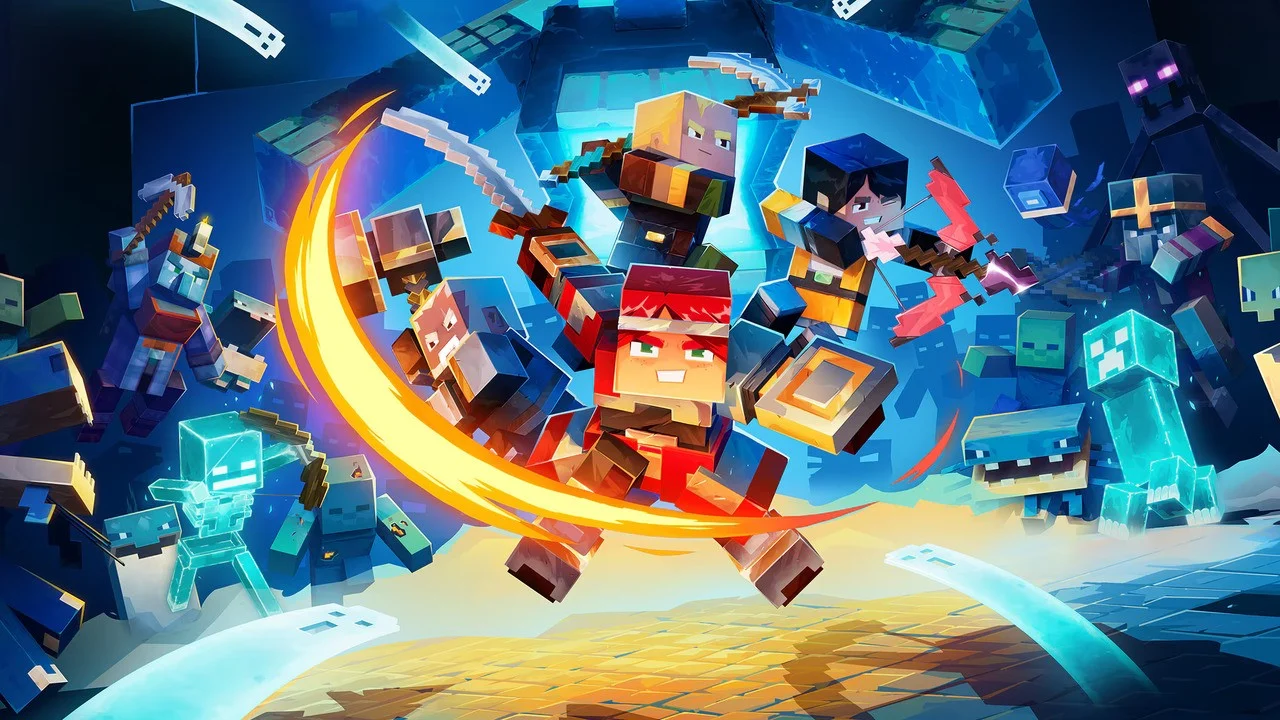
Minecraft Dungeons spun off from the main game in 2020 as a Diablo-like dungeon crawler brimming with character-building potential and co-operative fun for all ages. It boasts the polygonal art style and iconography beloved by fans, presenting a simple yet satisfying loot-based RPG experience. The sequel expands on this formula further by moving from episodic progression to open-world exploration and adding more depth to the basic combat and traversal loop.

The story, for what it’s worth, takes place in the continuity of the last game’s conclusion. The heroes of the land defeated the Arch Illages, but soon the overworld is invaded by the Illager High Council, a trio of nefarious magic users wielding soul power. These villains have also learned to navigate a mysterious new dimension called The Sift. Your created adventurer starts out in the hub town of Brave Haven, venturing into the overworld and helping the locals. As they expand the world map and fend off waves of enemy mobs, they encounter the High Council numerous times and uncover the mystery of The Sift.
Hordes of enemies roam every corner of the world: zombies, skeletons, spiders, creepers, Endermen. The list goes on, and you’re never far from a massive mob of them to churn through with your arsenal of weapons or spells. Endermen, in particular, are terrifying random encounters that net some juicy gear at the cost of your nerves.
As with the first game, customisation is still the most compelling part of this fight-and-explore loop. Loot spews from enemies and chests at a steady clip, and you’re never far from a fun upgrade that buffs resistances or reduces cooldowns. All weapons and gear can be enchanted for extra utility, expanding the depth of build experimentation even further. Artefacts grant up to three different crowd control abilities in exchange for soul power, while Talismans are new for the sequel and offer additional stat buffs and resistances. Outside of magical boons, jumping adds an extra variation to your melee and ranged attacks.

All this combines for a satisfying level of customisation, but it’s a shame there isn’t much variety in how you actually use your builds. You won’t be too far from Bright Haven before being able to fill the screen with explosions and spells…but you’re mostly using them against the same enemies in cookie-cutter locales.
The quest to defeat the Illager High Council is geared towards accessibility. It’s a family game that offers a lighter take on the ARPG template, but that also makes it a tad bland. In swapping out linear levels for an open world, Mojang has stretched the appeal too thin. There’s still a sense of discovery. Dungeons litter the Overworld, and portals into The Sift offer a new biome that’s lovely to look at.
Yet none of this distracts from the fact that there isn’t much going on in Minecraft Dungeons 2. Much like with Diablo and its ilk, the fun comes from wandering the land looking for the next source of shiny loot or overpowered enemy to tackle. The main story campaign is a breeze and clocks in at around 12-15 hours. There are tons of side quests and rifts to explore that will further expand your build capability with extra gear and talismans. The journey just isn’t that compelling while it lasts.

Luckily, you can liven things up by playing with others. Minecraft is a franchise built on its open approach to community, and Minecraft Dungeons 2 offers a full suite of co-op options. Couch co-op is bolstered by “mixed co-op,” which lets online players join your local adventure. The experience is seamless, and the game is much more entertaining when played alongside others.
Despite the smooth co-op experience, the game isn’t without its technical flaws. Performance is spotty in both docked and undocked modes, with patches of slowdown in the Overworld and during large mob fights. Frame rate is significantly lower for cinematics, which is always a jarring transition.
It’s worth mentioning that when stable, this game sings on handheld, feeling completely natural to play on the go. None of the other Switch hardware capabilities are utilised: criminal, considering how well mouse controls would work for this kind of game.

Bug-wise, I had a couple of issues with invisible (and invincible) enemies spawning during ambushes, which required a hard reset to fix. Meanwhile, enemy AI is often a mess, glitching into terrain and freezing. Several elite enemy ambushes were a breeze thanks to my attackers getting stuck on a wall, allowing me to use them for target practice.
Mojang is famously transparent about squashing bugs, with a public defect tracker for all to see and use, so these problems will likely be ironed out over time. For early adopters, though, the experience is noticeably uneven.
Conclusion
Minecraft Dungeons 2 adds some mechanical changes alongside a new open-world format, making for a distinctly different sequel. It’s a simple, bare-bones ARPG with a strong co-op experience that’s currently let down by some technical hitches.
Those jumping in at launch will likely be the established fanbase of either the franchise or the popular first Dungeons entry. Anyone else after a deep or challenging ARPG is unlikely to be won over.