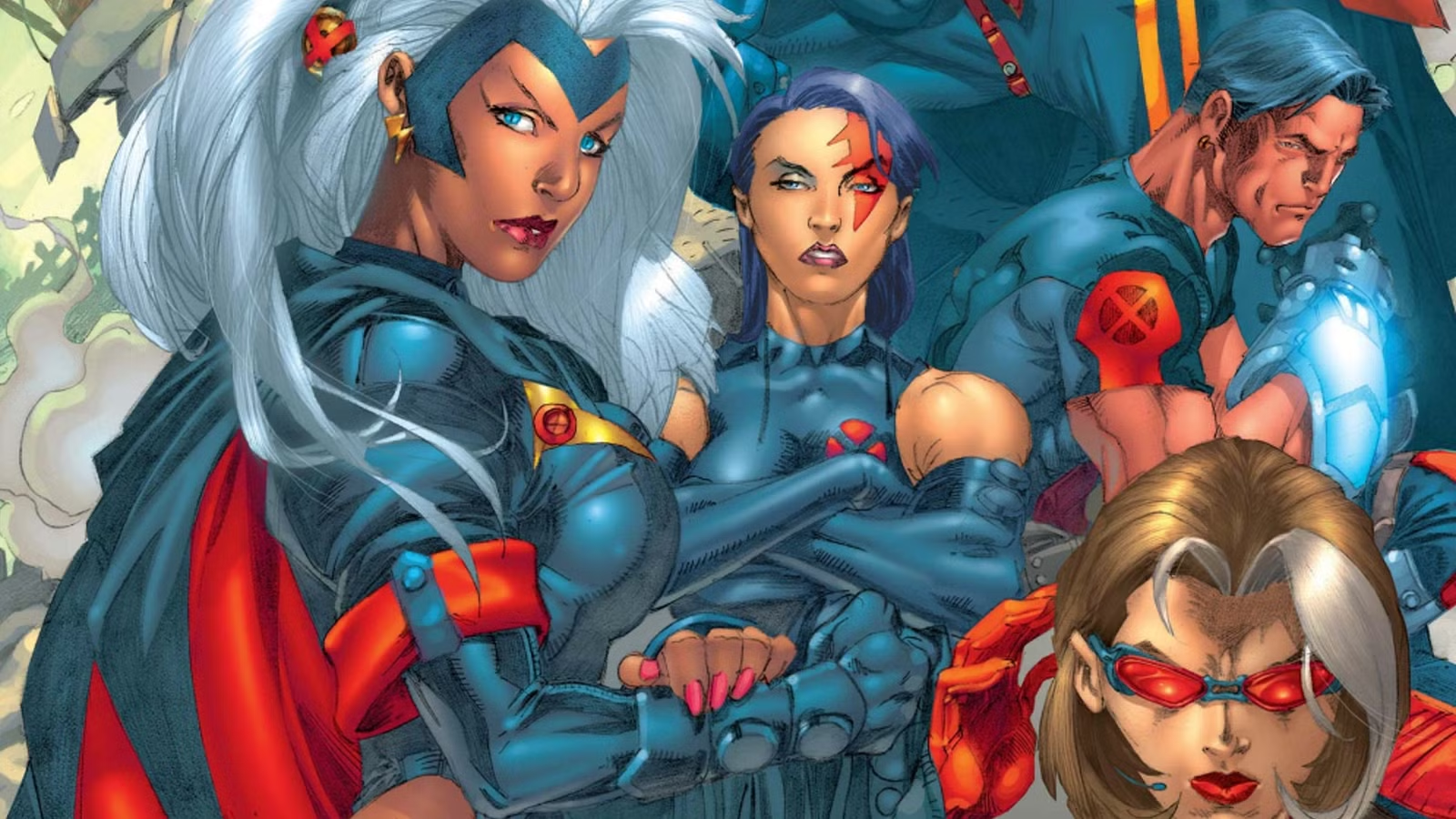
You could be forgiven for forgetting that X-Treme X-Men ever happened. After all, it was running concurrently with Grant Morrison’s New X-Men, which is widely regarded as one of the best X-Men comics of all time. X-Treme X-Men might not be the best, but it’s certainly one of the weirdest, and that has to count for something.
Writer Chris Claremont is well-known for his original run on X-Men, in which he and the artists he partnered with reimagined the team into the characters we know today. That run lasted from 1975 until he left the book in 1991. Claremont returned in 2000 to write both main X-Men titles, then was given X-Treme X-Men to make way for Morrison’s run. The X-books had gone a bit off the rails, and X-Treme was meant to get things back on track. Well…

X-Treme is often defined by its unresolved story ideas. The series kicks off with the intriguing (but quickly abandoned) plot in which the cast attempts to find the then-deceased precognitive Destiny’s mysterious diaries. It features a globe-trotting team that pops up all over the Marvel Universe via 4-6 issue arcs. While other X-books were often strictly grounded at the Xavier Institute, this team had no such restriction.
Some flaws appear instantly, such as the stylistic mismatch with the rest of the X-line. In fact, the X-Treme team is often at odds with the other X-Men. While this works to its benefit at times, it can also lead to an uneven read. When X-Treme does interact with other books, it can get messy, as with issues #20-23, an arc that sees Storm very nearly kill fellow X-Man Emma Frost.

Even with some obvious flaws, X-Treme X-Men is still relevant, especially if you’re already reading other X-books of the aughts. As with most Claremont comics, his knack for building complex character arcs is where the book shines. Most notably, Storm was somewhat rudderless through much of the 1990s. Here, she’s brought back into a central leadership role, and it suits her.
Storm’s story (and the rest of the series) eventually derails in its penultimate arc, “The Arena.” This is a baffling journey that begins with Storm joining an underground fight club and ends with her in a hot tub with her arch-nemesis. The two are no longer enemies, and are instead heavily implied to now be exploring a tentacle fetish (this sounds like hyperbole, but it’s not). “The Arena” remains infamous for its bizarre themes, and for being the moment that Claremont finally gave up on many of the unresolved plots of the series and simply let his freak flag fly.

Storm and some other notable characters ultimately benefit greatly from Claremont’s return. Long regulated to background status, the mutant Sage becomes a leading character in X-Treme. Sage is the X-Men’s resident computer brain, and this is essential reading for exploring her enigmatic character. The time-traveling mutant Bishop plays his last major role before taking a heel turn for several years. Rogue and Gambit are less central, but their relationship feels complicated and real during this era, primarily due to the care Claremont gives them.
Other characters don’t fare quite as well. This includes Psylocke, who is killed off early in the book (she’ll be back, but still). Another miss comes with the often derided Slipstream and Lifeguard, Australian siblings who are hyped as major new characters then forgotten about not long after. The Hellfire Club’s Elias Bogan is a huge deal, and then he’s not. Inconsistent? Sure. Still, 25 years later, X-Treme X-Men remains a wild ride.