
I had to remind myself recently that it’s been less than a year since we first saw Orbitals back at The Game Awards 2025. It feels like forever ago, not because the seven months since have been particularly packed — though they absolutely have — but because in that time, I don’t think a day has gone by where I haven’t felt excited to dive into this co-op sci-fi anime adventure.
Last month, that wait came to an end. Publisher Kepler Interactive invited me to a preview session, where I got to go hands-on with the opening 50 minutes, and I left with one massive complaint: How can I be expected to wait another three months to play more?
I’ll quickly fill in the blanks for those yet to have Orbitals infect their every waking thought. This Switch 2 exclusive is a co-op-only adventure game similar to It Takes Two or Split Fiction. You play as space explorers Maki and Omura on a quest to save their home station from the strange cosmic storm it’s trapped in.
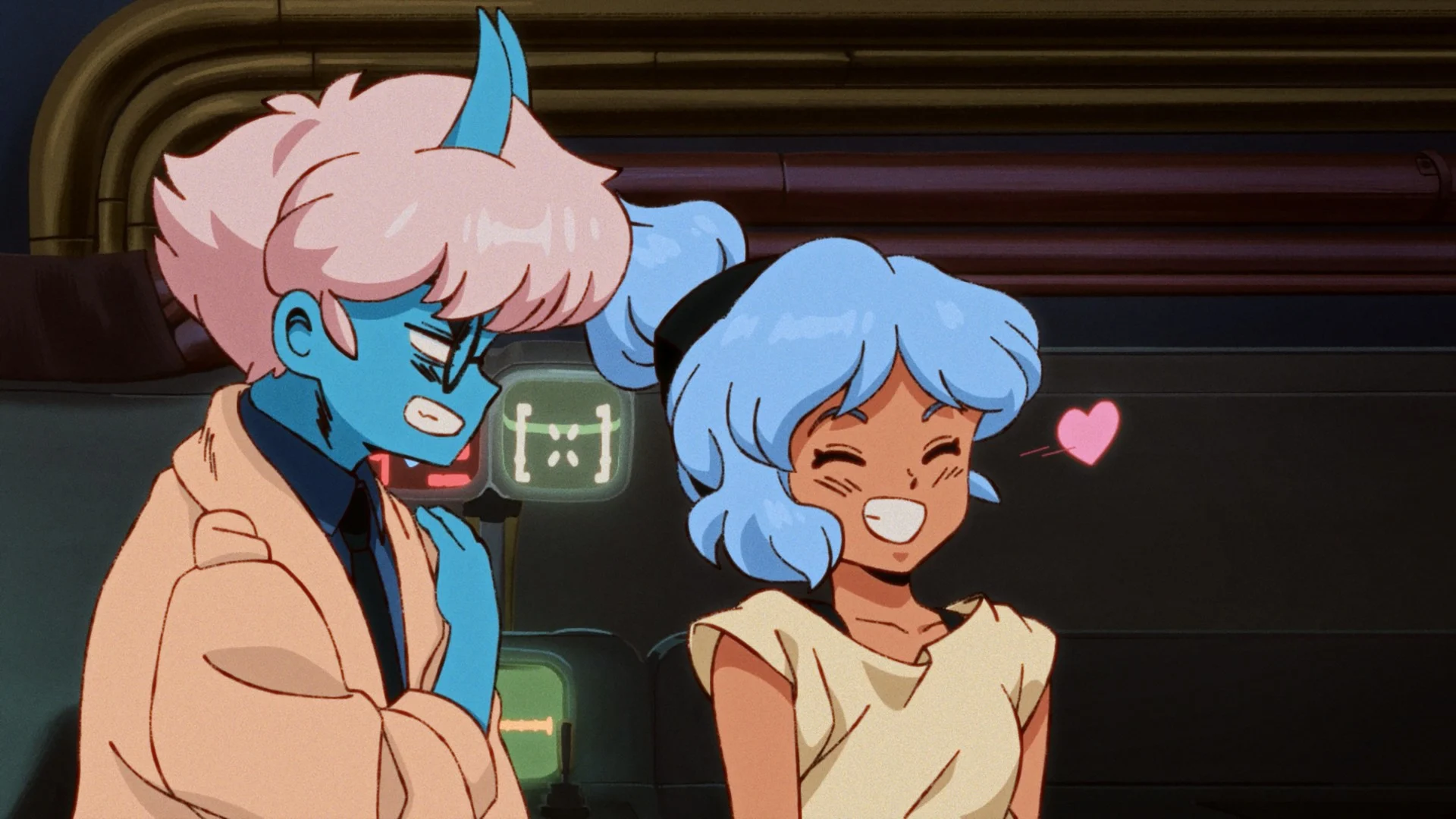
Sounds interesting enough, right? Well, here’s the best part: Orbitals is designed to look, sound, and feel exactly like a classic Japanese anime. Think original Dragon Ball, Sailor Moon, or Cowboy Bebop. That’s the vibe developer Shapefarm is going for, and I’ve got to say, it nails it. “If Netflix doesn’t spin this into a 22-part series,” I said to my co-op partner as we watched the opening cutscene, “they’ve missed a trick.”
Orbitals feels exactly like the cartoons I watched growing up, and it’s all thanks to the little things. The game intentionally runs at 24fps (12fps on background details) to emulate the movement of the genre source. Maki and Omura’s designs are tailor-made for cosplayers, and their movements — Maki’s arms-back Naruto run and Omura’s cool, Sanji-esque dash roll — immediately took me back to trying to emulate those very moves with my friends at school break time.
I’ll admit that the laughs and puzzle discussion from my hands-on demo table (and from all the other journalists in the room, for that matter) made the voice acting and music a little hard to hear, but from the snippets I caught, fans of synths and ’80s drum lines have nothing to worry about.
It all holds up remarkably well in the gameplay department, too. The game wasted no time throwing us into the kind of order-barking, co-op puzzle-solving that Hazelight Studio has dominated with in recent years. We were almost immediately given separate tools — one to pull open doors and one to extinguish the fiery contents within — and set about the usual, “Ohhh, so you need to do this and I need to do that” conversations that anyone who has played a game of this ilk will be familiar with.

There was a pleasing in-and-out nature to these early tool-based puzzles, with both my partner and me constantly switching up our abilities before the solutions could grow stale. Something I quickly appreciated was how we got to choose which of us took on which ability rather than them being pre-determined by our characters á la It Takes Two. It meant I never felt stuck with the less interesting of two tools, because I knew before long, I would get a chance to play with the cool one.
The puzzling itself had a satisfying level of difficulty where we rarely nailed it first go, but an initial attempt or two was all it took to show us the correct solution.
Of course, the challenge ramps up over time — we took a few runs at a mission that tasked me with escorting a soon-to-blow robot through an obstacle course, while my partner kept the bot’s explosions at bay from a nearby viewing area — but I never felt that we were bordering on frustration. Which is a fine line to walk for a game that many may play with partners who don’t have equal gaming experience.
We hopped between these ability-focused puzzle space stations in our ship, one controlling the movement and one controlling the weapons. There’s a satisfying Han-and-Luke-on-the-Falcon teamwork to the whole thing, and the space flight itself feels fittingly ‘open’, even if the next objective is always clearly marked.
We unlocked a handful of ship upgrades in the first 50 minutes alone, including new weapons, a Gust Jar-esque fan, and an electric bolt for powering up machinery. Neatly, you don’t both have to be at the controls to keep the ship moving — the person manning the guns can leave their station and wander as they please, while the other keeps an eye on the road — which is a welcome addition, because while I was the one in the driving seat, I could sense that some of the A-to-B-ness of the flight might be a little too long for the gunner when there’s nothing to shoot.
Just as we got stuck into another space station and its ground-pounding puzzles, our session came to an end, and from the sound of “Ohhhhh!“s that rippled across the room, you’d assume all our mums had collectively told us to turn off the TV and go to bed.
It took just 50 minutes of Orbitals to convince me that I need to carve out more time for it when it launches in the busiest gaming September of recent memory. I hope that those puzzles keep on evolving, I hope each space station is varied enough, and I hope the visuals continue to be so eye-catching that I’m distracted from my current desire for a Cowboy Bebop rewatch.
I can’t wait to see what else Orbitals has in store, because from what I’ve seen so far, it’s absolutely putting the ‘sauce’ in ‘flying saucer’.
Orbitals flies onto Switch 2 on 3rd September.
Will you be recruiting a co-op pal to dive into this one later this year? Naruto-run down to the comments and let us know.