After more than a decade of being the enthusiasts’ champion, Grinding Gear Games has planted its flag for Path of Exile 2 to become just as approachable as rivals like Diablo 4, if not more so. The biggest caveat for trying PoE has always been how immediately intimidating its sheer size and scope is, from passive skill trees with thousands of nodes, to complex crafting systems spread across a sprawling endgame of different activities. The PoE 2 0.5 update, Return of the Ancients, is a seismic shift that introduces the biggest single change since the ARPG first began its journey back in 2013.
With Path of Exile 2 Return of the Ancients, you can put build guides directly into the game. That starts with highlighting the exact path you should take through its skill forest, but it’s much bigger than that. Skill gems can be marked with their priority order, and the support gems you should target for each are separated out into their own tab. Hover over each slot in your inventory, and it’ll list tips for what to look for, right down to the order of importance for stats on every item. It can even be set to change dynamically as your level increases, ensuring it stays relevant throughout your playthrough.
This is obviously a huge win for action RPG newcomers looking for some help. I’d always encourage going in without any advice for your first time, but I know that’s too intimidating for some. If that’s you, it’s never been easier to see exactly what you need to do next without having to keep three different browser tabs open, flipping between those and third-party clients like Path of Building. It’s also great for those who actually craft their own builds, however, because you can quickly reference your plans right in-game without ever having to look away.
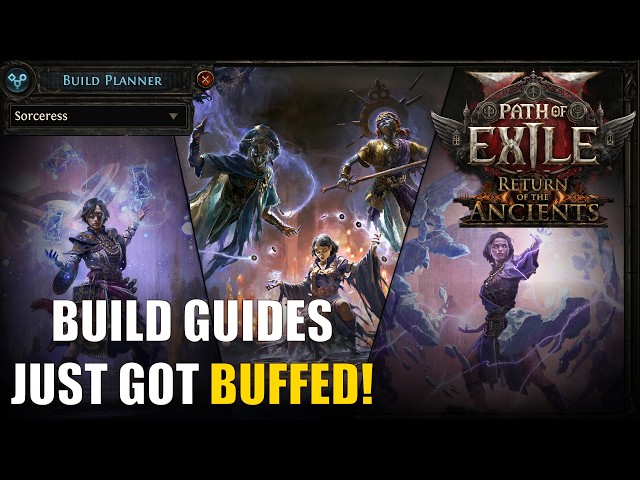
Speaking of Path of Building, which is the most popular way for people to theorycraft and test PoE builds due to its deep flexibility and number-crunching tools, the team behind it is already preparing to take full advantage of the new in-game integration. “Such a great feature,” developer ‘LocalIdentity’ writes, “We will be supporting it in Path of Building with an update before league launch.”
This isn’t just a big improvement for Path of Exile; it might even push it ahead of Diablo 4. While the skill trees in Lord of Hatred are simple enough that you don’t really need advice to make something that works, reaching the endgame and looking at the Paragon boards can quickly turn into an overwhelming mass of numbers. I typically play lots of different games, so I tend to fall back on Paragon layouts designed by experts who have already put in the hours – but that requires constantly flicking back to those browser tabs.
Path of Exile 2 still has plenty of more complex systems at play beyond this, but GGG is aware of those too, and it’s working to make them intuitive. While the massive endgame upgrade in Return of the Ancients might look scary at first glance, the separation of mechanics into specific zones, and the introduction of dedicated quests for each of them, will give you the opportunity to actually learn how each one works.

I spoke to Game Director Jonathan Rogers ahead of the reveal, and he told me he believes these quests should make the endgame much more like a continuation of the campaign, improving its accessibility. “Obviously it’s non-linear, because there are all these different objectives you can do in any order, but if you just want to get through all of these pinnacles, we can let you know exactly what to do to get them.”
On the crafting side, GGG has also tied particular material types to each mechanic, so it’s much easier to lay out a plan. You’ll soon learn that if you want better jewels, for example, you need to do Delirium (and if you forget, it’s easy for a build guide maker to tell you that). “By restricting each league to crafting specific item slots, it limits the amount of stuff you need to engage with at one time,” Rogers notes.
Put all of that together, and suddenly Path of Exile 2 feels more approachable than the series has ever been before, and possibly more so than even most of its peers. Rogers says that Grinding Gear Games “tried to build on all the functionality that we thought people might need” for 0.5, but expects that it will integrate more features in the future, as it looks to reach 1.0 launch by the end of 2026.