Trip Hawkins isn’t the sort of guy who’s afraid to take a risk and bet big. He founded Electronic Arts in 1982, around the same time that Atari’s fortunes were fading — and threatening to take the entire video games industry down with it. Ever since he was a kid, he’d wanted to create his own football simulation game, first as a tabletop experience, and later as a computer game for the Apple II and Commodore 64.
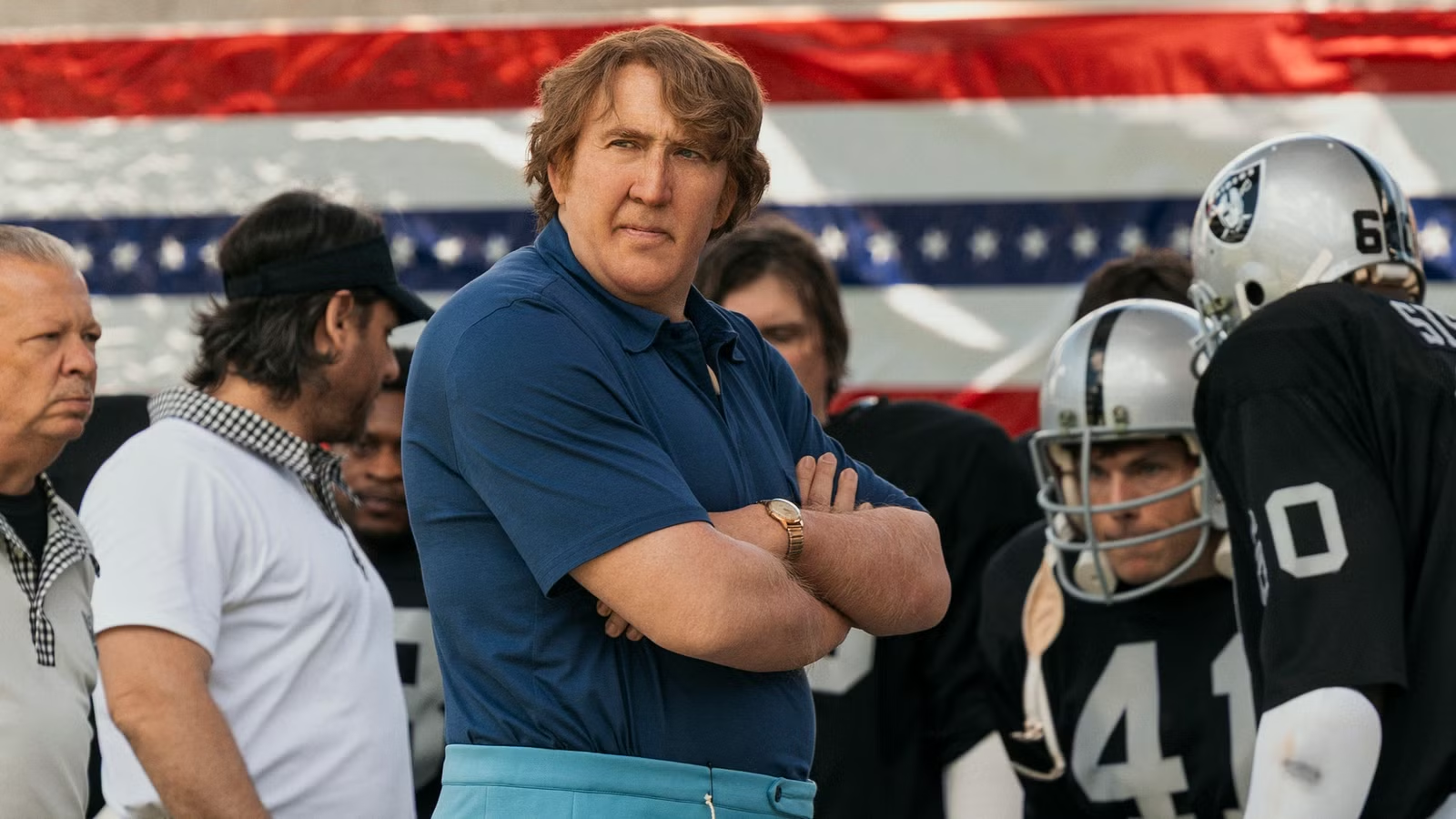
Hawkins is a major character in David O. Russell’s new film Madden, which hits theaters this week. It traces the football icon’s journey from coach to commentator to video game legend. Early in the story, Hawkins (John Mulaney) approaches Madden (Nicolas Cage) at a glitzy afterparty for Super Bowl XI in 1977, moments after the Oakland Raiders clinched their first NFL championship. Hawkins eagerly pitches a football computer game, but the coach is understandably distracted by the thrill of the occasion.
Hawkins keeps trying as the years tick by, eventually getting Madden’s ear during a cross-country bus trip. (Madden was notoriously afraid of flying and was driven to NFL games each week in a custom Greyhound bus called the Madden Cruiser.) Though the film takes some creative license with the timeline of how the game series came to life, Hawkins told Polygon in an interview ahead of Madden’s release that it gets a lot right about his relationship with the football icon.
“I was plotting and maneuvering for over a decade before I founded Electronic Arts. I was planning and preparing over a long period of time,” Hawkins said. “But I certainly didn’t have the budget to go to Miami and try to sneak into a Super Bowl party.”
Overall, Hawkins sees the film as an accurate portrayal of both sides of the John Madden he knew: a calculating on-field strategist and a Turducken-loving primetime commentator.
“When you’re dealing with John in a business setting, he’s deadly serious. And while he’s deadly serious and also dropping an F-bomb like every third word, John is a very intelligent guy. This is just one example of how smart he is — he never had a problem needing to get bleeped, you know, when he was on the air,” Hawkins explained.

“He figured out how to communicate with everybody,” Hawkins added. “He created a persona that was kind of emphasizing the lovable side of him, the big bear side of him. It was pretty clever of him to just create a character that he got to play as an announcer.”
The massive popularity of the Madden games is a major plot point in the film, but the series’ outsized role in the console wars of the early 1990s is only referenced obliquely. Armed with Madden’s original playbooks from the Oakland Raiders — yes, that plot point really did happen IRL — Hawkins was ready to bring John Madden Football to a 16-bit console. But he didn’t want to deal with Nintendo’s pricey third-party licensing. Instead, a team within EA spent a year reverse-engineering the Sega Genesis. That meant EA could produce software without Sega’s assistance, which gave them leverage to negotiate more favorable licensing terms with Nintendo’s biggest rival.
“I basically called Sega and said, ‘Look, this is what we’ve done. You know, we can all go to court and have a big lawsuit and waste everybody’s time. Or we can be partners and work together in the marketplace and try to beat out Nintendo in this 16-bit market segment.’ We were able to work out a lucrative arrangement where we could do that. And they knew that if they didn’t make it a really good deal for me, I would just go do it on my own anyway,” Hawkins explained.

Sega was working on a football game of its own, Joe Montana Football. Like Madden, it was set to be released in time for the holiday season of 1990, shortly after the Genesis launched in North America. But development wasn’t going according to plan. Sega CEO Hayao Nakayama called Hawkins in a panic, asking if he’d be willing to “cancel” Madden and instead release the game under the name Joe Montana Football. Hawkins came up with a clever solution that worked for both EA and Sega.
“Of course, I’m thinking to myself, ‘I really don’t wanna disappoint him and our relationship is really important to me, but there’s no way I’m gonna do that,’” Hawkins said. “I knew that this debut 16-bit game was a really great NFL football game. I knew it was gonna be the pivot point for EA Sports, and it was gonna really be able to make it take off. And as it turned out, I was able to tell Sega, ‘We’re still gonna put Madden Football out. ‘But I’ll make Montana Football for you also.’ And of course, like 98% under the hood is the program code from Madden Football. And I just gave a facelift and, no offense intended, but I sabotaged the game to make it inferior to our game.”
“The Montana game that we made had maybe less than 10% of the number of plays that we had at the Madden game,” Hawkins added. “I was able to deliver them the final version of Montana in six weeks.”
Get Polygon’s Wishlister newsletter
A weekly cheat sheet to what you’ll eventually love to play. No buying, no
commitment — just saving for later.
Free. Unsubscribe anytime.
Joe Montana Football omitted Madden’s pseudo-3D field and reduced the playbook from 113 plays to 13. Even so, Montana sold more than two million copies, compared to Madden’s 400,000. Still, Madden was a massive hit for EA and spawned a sequel the following year. The series has gone on to sell more than 150 million copies. For Hawkins, the last-minute project was worth it to get the game he’d been dreaming about for so long in players’ hands.
“I thought to myself, ‘Well, their marketing budget is way bigger than mine.’ Sega’s marketing is gonna dwarf what Electronic Arts can afford, and I don’t want anybody to know that they’re really, fundamentally the same game. I mean, our game’s better, you know, we took a bunch of stuff out,” Hawkins explained. “But that was part of the contract, that they couldn’t tell anybody where the game came from.”

Madden may not have touched on a lot of the behind-the-scenes games industry lore, but Hawkins says the coach was just as fond of talking about his namesake video game over a heaping plate of Santa Maria barbeque as he is in the movie.
“Uh, yeah. We ate a lot of meat,” Hawkins recalled with a chuckle. “John is a big, big time eater.”