
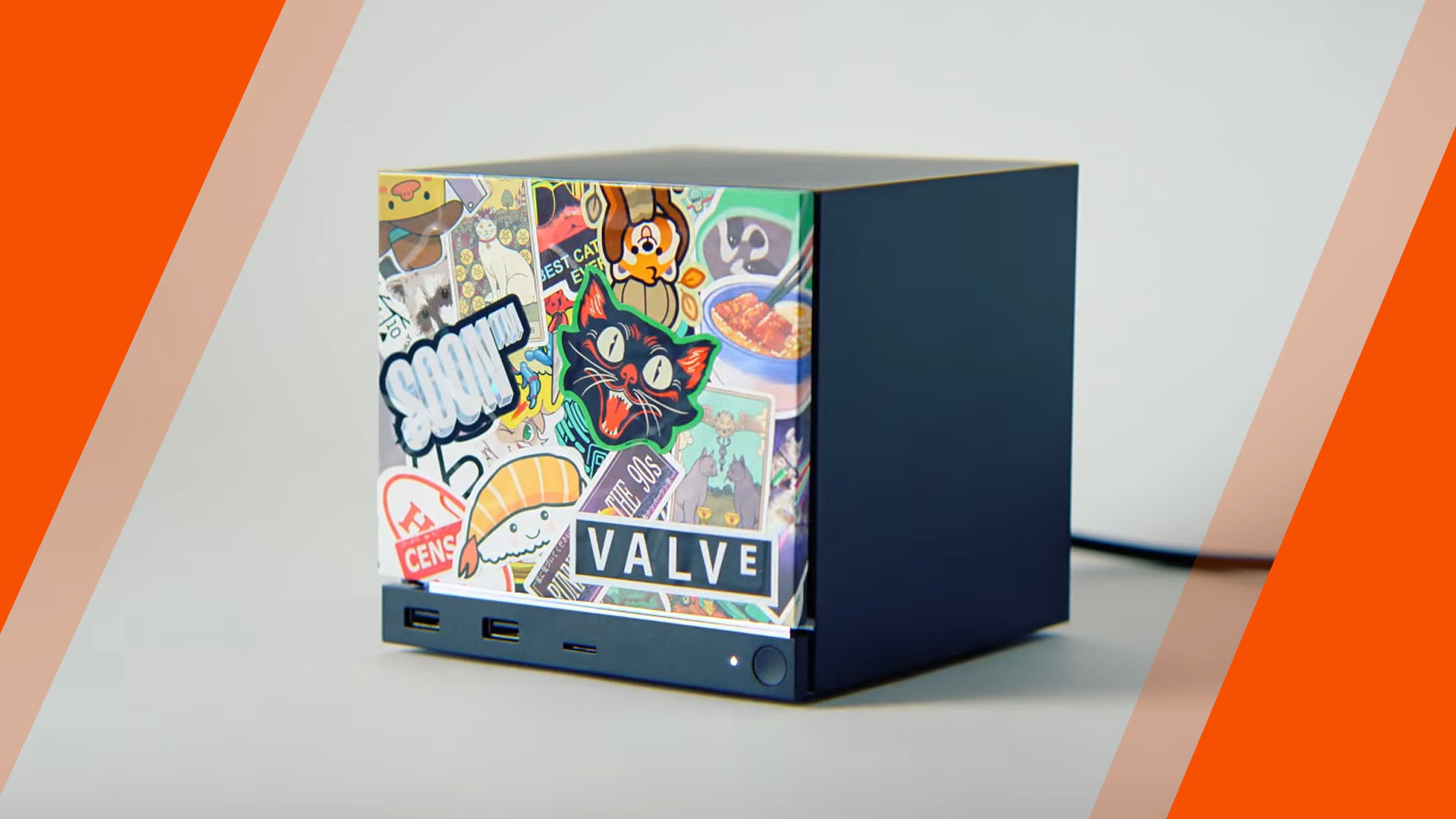
Find out everything you need to know about the Steam Machine with our comprehensive guide to arguably the biggest gaming PC hardware launch of 2026. The Steam Machine is set to revolutionize the living room gaming space, thanks to Valve creating an incredibly compact console-like system that you’ll be able to game on from the comfort of your couch.
If you’re just getting started on Valve hardware then be sure to check out our Steam Controller review to see what they just shipped, and our Steam Deck review too. Combining the best of that kit and SteamOS, the Steam Machine should make it easier than ever to play your Steam game library without needing to fire up your main gaming PC or resort to using a keyboard and mouse. The Steam Machine was expected to be one of the best gaming PC options around when it was announced, thanks to its compact size, claimed 4K-capable gaming performance, and expected low price. With recent PC component price rises, though, the Steam Machine price is high, and its feat as a world-changing device seems set to hang in the balance. Read on below to find out everything you need to know about the Steam Machine.
Steam Machine specs
These are the Steam Machine specs:
| Steam Machine specs | |
| CPU | Semi-custom AMD Zen 4 six-core/12-thread (up to 4.8 GHz, 30W TDP) |
| GPU | Semi-Custom AMD RDNA 3 28CUs (2.45GHz max sustained clock, 110W TDP) |
| RAM | 16GB DDR5 + 8GB GDDR6 VRAM |
| Storage | 512GB NVMe SSD or 2TB NVMe SSD |
| Networking | 2×2 Wi-Fi 6E, Bluetooth 5.3, integrated 2.4GHz Steam Controller wireless adapter, gigabit Ethernet |
| Ports | Rear: 1 x DisplayPort 1.4, 1 x HDMI 2.0, 2 x USB-A 2.0, 1 x USB-C 3.2 Gen 2 Front: 2 x USB-A 3.2 Gen 1 |
| Extras | 17 individually addressable RGB LEDs for system status and customizability |
| Dimensions (WxDxH) | 156 x 162.4 x 152mm |
| Weight | 2.6 kg / 5.7lbs |
Steam Machine size
The most remarkable spec of the Steam Machine is its size. Measuring just 152mm tall (148mm without feet), 162.4mm deep, and 156mm wide, it’s a fraction of the size of even most mini gaming PCs, let alone typical full-size systems. For comparison, the likes of the hugely popular Fractal Design Terra mini-ITX case measures 343 x 153 x 218mm, while a typical ATX case like the NZXT H6 Flow measures 287 x 415 x 435mm.

This incredibly compact size means the Steam Machine can easily sit unobtrusively on a desk – no need to hide your PC under it – alongside a work laptop, for instance. Or, it can nestle in amongst your PS5, Xbox Series X, and AV equipment next to your TV.
Steam Machine Graphics
This size does come with some compromises, though. Yes, not even Valve can fit an all-conquering RTX 5090 graphics card and AMD Ryzen 9850X3D CPU into a box of this size. Instead, the Steam Machine relies on semi-custom AMD chips for its gaming horsepower. The company hasn’t explicitly said whether these are separate CPU and GPU chips, or whether they are integrated into a single APU like on the Steam Deck. However, what we do know is they have much higher specs than the Steam Deck, but much lower specs than truly top-tier gaming PCs.
The CPU uses AMD’s older Zen 4 architecture, rather than its latest Zen 5 design, which is a significant upgrade over the Steam Deck’s even older Zen 2 design, but still means the Steam Machine is not truly cutting edge. The chip also has just six cores, putting it on par with the Ryzen 5 7600X. That’s more than the four cores of the Steam Deck, but behind the eight you’ll find on the best gaming CPUs, such as the Ryzen 7 9800X3D.
These cores can handle two application threads at once, though, so the chip appears to SteamOS as though it has 12 cores. It also runs at up to 4.8GHz, which is much faster than the 3.5GHz limit of the four-core CPU in the Steam Deck.

As for the GPU, this is again based on the older AMD RDNA 3 architecture, rather than the RDNA 4 design used in the company’s latest graphics card, such as the RX 9700 XT. Again, though, it’s much newer than the GPU in the Steam Deck, which uses AMD’s RDNA 2 architecture.
What’s more, this GPU has far more compute units (CUs) than that of the Steam Deck. It has 28 CUs compared to the Deck’s eight CUs. Along with a much higher peak clock speed of 2.45GHz and a total power envelope of 110W (compared to the Deck’s 15W), this is altogether a far more powerful unit.
For comparisons to a desktop graphics card, the Steam Machine’s GPU is close to the spec of the RX 7600. That card also uses RDNA 3 but has 32 CUs. Meanwhile, the laptop RX 7600M has the same 28CUs as the Steam Machine, and that chip typically can hit around 60-100fps in mode games running at 1080p.
Steam Machine performance
Here lies the crux of the expected performance of the Steam Machine. Its GPU simply won’t have the power for native 4k gaming in any but the most graphically basic games. Instead, by Valve’s own admission, the system relies on AMD’s FSR upscaling to upscale from 1080p to 4K, to hit 60fps.
In general, we’ve not been all that impressed by AMD FSR upscaling, and certainly would be wary of using it to try and play faster-paced games with a keyboard and mouse on a gaming monitor, when upscaling from 1080p to 4K. However, for use on a TV and when relying on the more forgiving inputs of a Steam Controller – or other gamepad – it should mean acceptable performance.
Early performance tests show the machine is able to hit its upscaled to 4K performance target in a decent number of modern games, although its weak ray tracing performance means it struggles in games where this is required. The likes of Indiana Jones and the Great Circle and Doom: The Dark Ages struggle to hit 40fps even on low settings.
As for other aspects of the Steam Machine’s specs, it’s set to ship with 16GB of RAM and have a dedicated 8GB of VRAM, both of which should be adequate for running most modern games. There has been a lot of talk recently about graphics cards with only 8GB of VRAM being performance-limited in modern games, but SteamOS is far more efficient than Windows, so we don’t foresee this being an issue for the Steam Machine.

In terms of IO, you’ll get one DisplayPort 1.4, one HDMI 2.0, two USB-A 2.0, one USB-C 3.2 Gen 2, and a gigabit Ethernet port on the back, plus there are two USB-A 3.2 Gen 1 ports on the front.
Livening up the otherwise simple black box is a lighting strip on the front edge, which has 17 individually addressable RGB LEDs “for system status and customizability.” You can also swap the front panel for other funky designs, plus, of course, many companies have already developed skins for the Steam Machine, such as those by Dbrand. Oh, and how could we forget the Dbrand case that makes the Steam Machine look like a companion cube.
Steam Machine release date
The Steam Machine release date is June 25, 2026. Valve has opened a pre-order queue system where you sign up – via this link – then, on June 25th, there will be a random draw that will determine who gets to buy one of the units. You’ll need to sign up before June 25 to be in with a chance of buying straight away.

Steam Machine price
The Steam Machine price starts at $1,049 / £879 for the 512GB model without a controller. This rises to $1,428 / £1,208 for the 2TB model with a Steam Controller. The full list of options are:
- 512GB model without a controller – $1,049 / £879
- 512GB model with a Steam Controller – $1,128 / £938
- 2TB model without a controller – $1,349 / £1,149
- 2TB model with a Steam Controller for $1,428 / £1,208
These prices are far higher than many people predicted when the Steam Machine was first announced, and even Valve has admitted it’s more than it had thought it would have to charge. However, unfortunately, the current situation with PC gaming is that many components are just too expensive right now. RAM quadrupled in price mere weeks after the Steam Machine was announced, and its price has hardly dropped back down much since. SSDs, VRAM, GPUs, and more are also much more expensive right now than this time last year.
You might hope that Valve could charge less than this and make back its losses on commission from games sold via Steam, just like console makers sell the devices at a loss to make back money on the games. However, the Steam Machine is just a PC. Someone could buy one, load Windows onto it and never use Steam again. Valve has to sell them at a price that at least breaks even.
Meanwhile, for comparison, a typical pre-built gaming PC with an RX 7600 and 16GB of RAM costs in the region of $900-$1200 right now, depending on a few factors, including the amount of SSD storage. The Steam Machine comes with a few advantages like HDMI CEC and wake via controller, but the above PC will simply be more powerful as well as cheaper.
That’s all you need to know! Now follow PCGamesN for more of the latest PC gaming news.