In 2012, Serious Sam developer Croteam made its mark on the puzzle game genre with a riff on Portal that traded in physical comedy for philosophical musing. As if its exceptional puzzles weren’t brain-bending enough on their own, The Talos Principle looked for higher purpose in a hard sci-fi story that searched for signs of humanity in a world populated by cold androids. It kicked gaming’s dystopian instincts to the curb to deliver an optimistic exploration of artificial intelligence.
You can see where this is going. Fourteen years later, the team is hard at work on the series’ grand finale, The Talos Principle 3. It’s being created in a very different context than either of its predecessors; what once was pure sci-fi has now become an inescapable anxiety, thanks to the very real rise of generative AI. That’s left Croteam frustrated as its thematic intent has gradually been muddied by LLMs, but the studio isn’t changing course because of a few chatbots. It’s going to finish The Talos Principle story the way it always intended to.
“It actually spawned into this world more like an accident,” Croteam CCO Davor Hunski told me when I spoke to members of the team in a video interview. The story goes that Croteam was hard at work on a new Serious Sam game, and Hunski was trying to solve a hyper-specific problem: What would be a fun way to have players unlock doors that didn’t involve key cards? Hunski started playing with a device that let players jam doors, and that opened the creative floodgates at Croteam. Soon, games like Flow became a point of inspiration for a bombastic shooter. The experimentation took on a life of its own, so Croteam spun it off into its own game and pitched it to Devolver Digital. Despite expecting to see Serious Sam 4, Devolver enthusiastically approved the idea.

The Talos Principle launched in 2012 to immediate critical acclaim. It was praised for its brainy puzzles, which had players juggling gadgets, and for its thoughtful story about transhumanism. It was followed by The Talos Principle 2 in 2023, and a remake of the first game dubbed The Talos Principle: Reawakened in 2025. Earlier this year, Croteam announced that it would end the series with The Talos Principle 3, though it has only gotten a small teaser trailer so far. While details are sparse for now, Croteam gave Polygon an idea of what to expect from the ending.
“The first game is about birth. The second game is about life. And the last game was about, you know, what comes after,” writer Verena Kyratzes told Polygon.
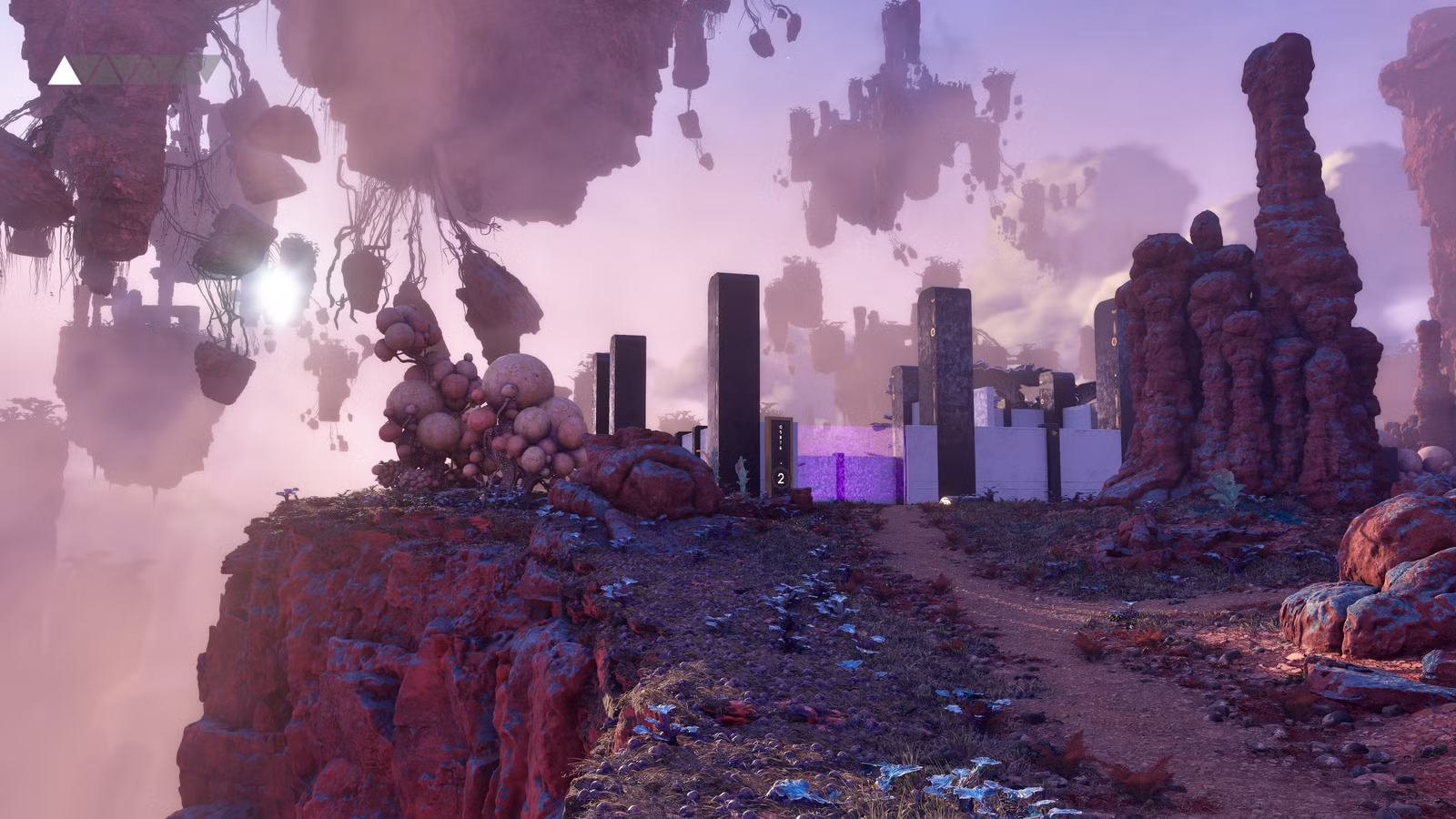
The story takes place in The Anomaly, a mysterious space where the laws of physics don’t apply. Androids are drawn to it, with some believing they will find God there. You play as a member of an expedition gone wrong, who winds up stuck in The Anomaly watching their past experiences recreated by the place. Croteam said that the idea was conceived during development of the first game, with the intent being that each game would explore a piece of a life cycle: birth, life, and death.
“What drew me to the story is this discussion of: Do you believe in life after death, or don’t you? Is it something to be afraid of, or can you find hope in that? Is there a continuity of the soul?” Verena Kyratzes said. “I’m not necessarily saying that I believe in that, but I think it’s a very interesting discussion to have. Maybe if you’ve lived a good life, then the next step isn’t so scary anymore.”
If you’ve played a Talos Principle game before, then it’s likely no surprise to hear that my conversation with the team delved less into game details and more into philosophical debate. As writer Jonas Kyratzes discussed how the project deals with immortality as a concept, asking its players if they would choose to take that option if humanity cracked the code, I joked that I wouldn’t want to live longer than I have to.
“You will get older,” Hunski said, piercing my ironic veil through the screen. “You will change your opinion.”
“If you were 100 years old, but your body was 24?” Jonas Kyratzes followed up. “A lot of the time it’s like people are like, ‘Oh, I don’t want to live a thousand years because I would have to work for a thousand years.’ Your problem is your job! The problem is you’re extremely alienated from your labor! The problem is not that you don’t want to live a thousand years!”
Fair play, but you can’t blame me for being exhausted by the current state of the world. High among my own list of concerns at present is the tech industry’s generative AI craze, which threatens to upend that labor problem by forcibly ejecting those alienated workers from their jobs. It’s hard to be optimistic about where that could lead if left unchecked.
We tell this story because we think that a lot of people don’t have hope.
That puts The Talos Principle in a strange position as it gears up for its final act. The series was rooted in sci-fi tradition, following a long history of works about AI that predated today’s tech landscape. Philip K. Dick wasn’t writing commentaries about ChatGPT in the 1960s, but it’s inevitable that his work might be interpreted through that lens today. The same goes for The Talos Principle, especially since Reawakened revived the first game’s AI optimism in the middle of a heated moment. I asked Jonas Kyratzes if it bugs him that The Talos Principle 3 could be interpreted as a modern commentary on generative AI.
“I actually think that the issue is that people have been annoying me with that since the first game,” he said.
For Jonas, The Talos Principle isn’t interested in figuring out how the tech could or should work, but rather using it to ask questions about humanity. He’s more interested in discussing materialism, and asking if consciousness is something that can be created by human beings by arranging matter in the correct order. Even if those questions did intersect with today’s tangible discussions, the tech we’re interacting with today isn’t the AI he’s talking about.
“We have this weird phenomenon where we call things artificial intelligence that aren’t artificial intelligence, and now we’re all talking as if we had artificial intelligence,” he said. “That creates a very weird thing where we’ve been given a linguistic version of the future, but we haven’t been given an actual future. We have the signifier, but not the signified. It’s a bit like if you told me we had warp travel, but it was just a tunnel. We have something very interesting in LLMs and in machine learning, but also we have a bunch of dumb companies randomly spending tons of money that they don’t know how to make back.”

There are still places where The Talos Principle 3 intersects with generative AI debates, though indirectly. Jonas said that, like The Talos Principle 2, the third installment is about “imagining a better world and imagining better applications of technology.”
“We see the lives that these beings live. And a theme that recurs in the game is that they live relatively ordinary lives,” he said. “Some of them go to great extremes — one of them becomes a planet — but a lot of others live an ordinary life because an ordinary human life, if you strip away the problems that we have in our society, is a very good thing. The idea that an artificial intelligence would be something very alien to us is something that the games oppose… There’s a recurring concept in the games that what they’re trying to do is not to be more than human, but to be more human.”
That’s where Croteam’s optimism comes in. Hunski noted that the series was originally inspired by Star Trek and astronomer Carl Sagan. It’s not cynical, nor does it present its robot civilization as a dystopia. It’s more nuanced than that, and that flows from the compassion that the team has for human beings.
“We do beautiful things all the time and people are still capable of goodness all of the time … with the exception of a handful of people who are damaged by this world,” Jonas said. “That is something that comes up in 3 as well. When we see fictional other worlds and their histories, something to consider is: Are individuals to blame for this? Do we go like, ‘Oh, it’s Elon Musk, it’s Donald Trump, it’s Kier Starmer?’ There’s a kind of compassion in understanding that systems produce these individuals and put them in positions of power. It’s not that this or that person is uniquely evil or uniquely corrupt; it’s that something historical is happening. While that’s very scary, it’s also hopeful, because it means that it’s not the individual people who are to blame. It’s just that we’re all trapped in this machinery.”

Verena Kyratzes recalled a conversation that she had with her father about AI. He said that he didn’t want it to exist because he was sure it would be evil. His reasoning? “Because the people who program it would be evil.” Verena admitted it was a fair point, but countered with another hypothetical: “But what if they weren’t?” Call it optimism or naivety, but that question is what powers the series. Croteam refuses to admit defeat, which is why it isn’t backtracking on its philosophy with The Talos Principle 3. If anything, the grim state of the world has only given the team more reason to say what it wants to say.
“We tell this story because we think that a lot of people don’t have hope, because they don’t see the hope,” Verena said. “A lot of the narrative out there — not just in games, but movies, books, et cetera — is dystopian. If we don’t tell those stories, then people will not believe that there is still hope. I look out there, and I also think, okay, we’re screwed. But what if we weren’t? What if enough people could hope again so that something could change?”
“I know that Talos Principle is just one game against this giant flood of dystopian narratives, but we have to start somewhere.”
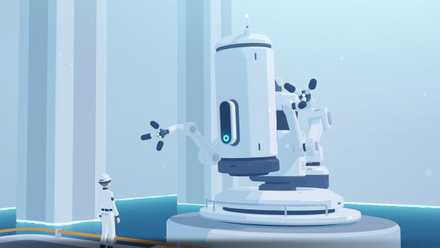
Can Annapurna pull off another Mixtape with a brainy sci-fi game?
The timely D-Topia asks if a perfect utopia could ever exist