AP Thomson, game designer and developer of Titanium Court, is a man after my own heart. Yes, exactly. I mean a Golden Sun lover.
I ask him to introduce himself as a warmup question for our interview, and about two sentences in he catches sight of the pack-in instruction manual for Game Boy Advance classic Golden Sun on a floating shelf behind me and points it out.
“Is that an instruction manual? Like right behind you? Is that the original or is that The Lost Age? [It’s the original. I pick it up and give him a closer look.] Oh yeah. I mean, both of those are really good. I love the first two. I think the second one I played over the course of a weekend and I think that was the first time I’d ever done that with a game that long.”
A merrier hour was never wasted there
Thomson’s I Spy easily segways into an answer to what I originally asked him: Who is he? What is he about? Some element of that is, he says, handheld games. He went on road trips with his parents a lot as a kid and brought the GBA along. He also recalls playing it while just sitting around with his family in the evenings when he didn’t have a choice of what was on TV. It turns out that craning your neck in the back seat of a car or in a weirdly shaped armchair just to finish a dungeon is formative.
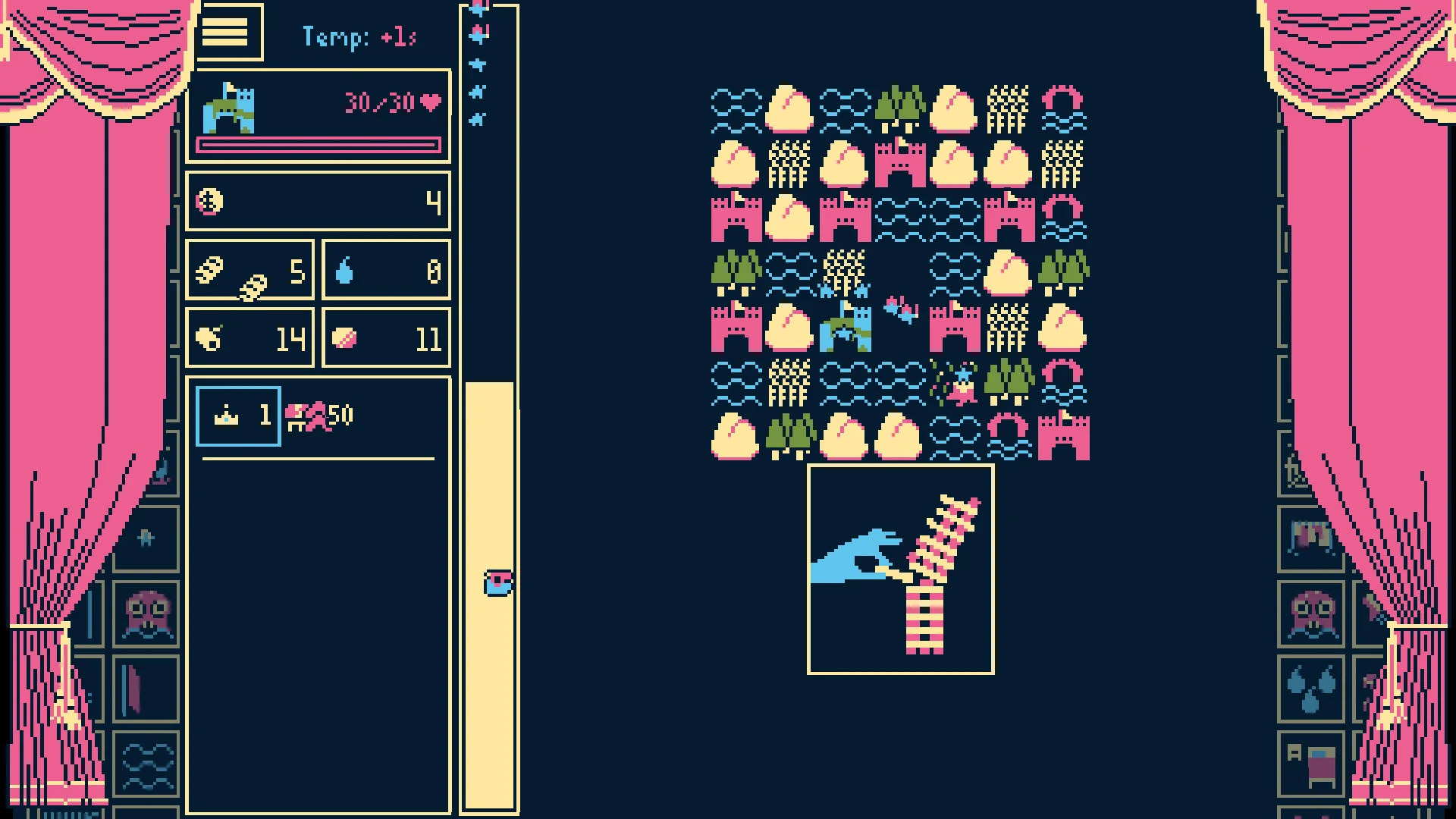
Which maybe explains, at least in some small part, the look of Titanium Court. There’s something visually handheld-era about it, with its tiny sprite-like characters and simple color palette, the latter of which Thomson explains as a scheme he borrowed from Downwell to stop himself from picking colors that didn’t go well together. I play Titanium Court mostly on my TV via a complex PC set-up. Once, I try it on Steam Deck, where it feels right at home.
Titanium Court is a “match-3 tower defense for people who like to read,” as Thomson explains it, a pitch that he thinks is rather similar to The Return of the Obra Dinn’s “an insurance adventure in minimal color” in that both describe themselves “accurately in the least appealing way possible.” I’ve been telling my friends it’s like Fire Emblem: Three Houses, but with a tower defense/match-3 mashup in the tactics sections, and the casts of A Midsummer Night’s Dream and the musical Pippin running around the Navidson house instead of the academy exploration bits.
Yes, Titanium Court is quite difficult to explain to others, a fact that Thomson himself has riffed on in its trailers. As he tells me, it’s not impossible to describe. But, “when you describe it in traditional terms, you don’t really get an actual accurate picture of what the game is.
“A thing that I noticed probably like sometime last year is that I had been describing it in very simple mechanical terms for quite a while, but…whenever I described it this way to someone, if that person then goes on to playtest the game, I actually noticed a pretty clear correlation between describing it to someone in those terms and them proceeding to skip all the text. And I know that this is like the gamer way. This is, you know, a tradition. But also I think the key realization for me is that when I did not explain it in those mechanical terms to people, they would not skip all the text.”
Often, games that are billed as “solo dev” efforts are not actually so. Titanium Court technically isn’t either, but it does get close. Until last fall, the game was all Thomson “in terms of touching the keyboard and moving the mouse making changes in the game.” He says he did have the help of playtesters and people giving feedback. And then Fellow Traveler came onboard as a publisher, and Thomson hired editors to go over all the text.
But the game is very purely his own vision. It began in 2019 as a Ludum Dare project on the theme “start with nothing,” which Thomson said he deliberately ignored in favor of making a tower defense game called Little Beetle Bottle Battle. It was purely mechanical at the time: players would select all their units before a battle, and then the battle would proceed automatically in real time. That was it. 48 hours of work. Following Ludum Dare, Thomson shelved Little Beetle Bottle Battle to work on Consume Me with Jenny Jiao Hsia and some side projects, and then in 2020 decided to revisit it. At the time, he believed Little Beetle Bottle Battle could be turned into a final version called Titanium Court in one year. It took six.
Titanium Court is, as a result, full of AP Thomson, made up of all sorts of strange little pieces of Thomson’s experiences and thoughts. Its main character is a woman who finds herself unexpectedly the queen of a faerie court ministered to by Puck of A Midsummer Night’s Dream fame, which Thomson says was the first ever Shakespeare play he saw. Early on, the character drinks a love potion and starts enjoying baseball as a result, a plot point he modeled after his own experience of trying psychedelics for the first time.
That’s also where he got one of the game’s silliest running gags: none of the faeries believe that cars are real.
“I don’t know if you are a person who’s ever tried psychedelics before or what your experience is, but it’s pretty common if you are with people who are a lot more experienced with it, that they will kind of give you like a little bit of a heads-up about things that are going on. And one of the things that I remember distinctly being told to me is, if you think you can fly, start from the ground, and cars are always real. So when I was thinking about that scene, I was like, wouldn’t it be funny if fairies just didn’t believe one of these two things?”
The unique art style of Titanium Court, which features a lot of over-exaggerated still images of characters being wiggled all over the screen, is modeled after campy stock photography, combined with what Thomson describes as Fire Emblem: Three Houses’ “patented Shake-A-JPEG technology.” He tells me about his amusement playing Three Houses and seeing all the expensive-looking, carefully choreographed anime cutscenes, only to reach a major story scene where a character turns into a dragon and it’s just a still JPEG of a dragon with character dialogue boxes popping up over it. It looked ridiculous, so he adopted something like it for Titanium Court.
Three Houses also informed some of the character development, especially of the protagonist who finds herself nominally in charge of the court. As Thomson explains, Three Houses presents a humorous disconnect between what the game wants you to think the protagonist is like, and what they actually are like “based on the incentives created by the structures in the game.”
“The game wants you to think of them as this classic ultimate chosen one badass hero. But then you look at how they behave in the actual game. Because fishing doesn’t take any resources or any time during the academy parts, you have this incentive to maximize your fishing every single time you’re walking around the school because it gives you a bonus…so it really just feels like this character would rather be fishing. Like, born to fish, forced to Chosen One. Which is a much funnier and more interesting character than a blank slate chosen one or whatever they’re trying to present to you in the story.”
“…I just think that it’s good to let characters in when you’re designing a game and a character in a game, let the character tell you who they are. And once you have that, once that character has told you who they are, now you can lean into that and have a little bit of fun with it.”
Titanium Court’s music, too, is all Thomson’s work, and the best of it comes out of a skill he developed pretty recently. Though he was already working on making digital music prior, in 2021 he decided to learn guitar during lockdowns with the goal of practicing enough to be able to make songs for the game. Originally, his plan was to have lyrics for all the songs that would only play during boss fights. But all the songs he wrote had three to five minutes of lyrics, and battles are only 30 seconds.
So instead, the battles are all instrumental. And after a certain point in the game, the player can choose to watch a full in-game video recording of Thomson playing and singing a song in order to skip a boss fight and win it automatically. The first one the player encounters, entitled “F*ck Off And Die,” is about salmon spawning and dying. I was going to show it to you but somehow it’s not up on YouTube yet!
Anyway, yes, Titanium Court lets you skip boss battles. There are no explicit “difficulty” settings, but there are tons of little in-universe features Thomson has slipped in to make the game easier or harder, depending on how you want to play. I managed to eventually unlock a feature that let me skip all the gameplay bits entirely and just spend my time exploring and speaking with people. But whenever you do choose to engage in the match-3 tower defense stuff, a thermostat in the main character’s office can be toggled to “comfort” or “strife,” opening a randomized menu of perks that will make fights easier or harder. There’s no penalty to choosing comfort, either. In fact, Titanium Court rewards the player for committing to either comfort or strife for long enough, and its characters will opine on the benefits and drawbacks of both.
“I think the stance I kind of ultimately take is that we should have a little bit more fun with difficulty,” Thomson explains. “I think that both sides of the discourse make perfectly reasonable points. I think that having just an easy, medium, hard in a lot of games, that’s somewhat arbitrary. That’s not really telling you that much about what that actually means. It’s also not in constant negotiation either. It’s frequently a decision that you make at the beginning and then never think about afterwards.”
No more yielding but a dream
When I spoke to Thomson, I was nearing the end of Titanium Court. Given the game just came out, I didn’t want to ask him too many details about the ending and risk ruining its many surprises and genuinely emotional moments of player decision-making. But I did want to hear his thoughts on some of the themes present in the second half, especially as regards Titanium Court’s commentary on a player’s relationship with a video game as a piece of art. Without getting too deep into it, the second half of Titanium Court challenges the player very directly on how much of the game they really want to consume, or when it’s time for the game to end. It’s an approach I haven’t really seen taken by a game like this before:
“I think that there is a mode in which a lot of players play video games that involves basically slurping the whole thing up,” Thomson says. “Seeing everything they’re able to see, unlocking every single achievement, the 100-percent playthrough and everything. It’s a valid way to play games. But on the other hand, I do want to push back against it, because I think that some of my best experiences with games as a player have been when I have left them, not necessarily unfinished, but leaving large aspects of them unexplored. I think that by doing that, the game can occupy your imagination in a far greater capacity than if you explore every single nook and cranny, you see exactly everything the game had to offer. I think that one of the things that games are great at is living large in our imaginations.
“…The latter half of Titanium Court is trying to say, ‘Did you know that if you do not overstay your welcome with fairies, you’re gonna have a much better time?’ That ties into what the game is ultimately trying to do. It’s trying to change the player. It is a spell that is cast in their direction.”
As we wrap up, Thomson shares something with me I’ve never seen any interviewee do before. Knowing he was going to be doing interviews with multiple outlets, he came up with a bunch of fun stories from the development process to share, presenting a different one to each interviewer, so everyone had something unique. Here’s the one he told me, and I’m furious I only learned about this at the end of Titanium Court when it was too late to see most of what he’s talking about in action:
“Every character in the game who speaks, they either speak with red text or blue text. That was very intentional. You’ll notice that characters will generally not switch the color of their text, except for a few special cases where a character undergoes some kind of change, in which case maybe their text color changes. But that was a writing constraint that I originally put together. Generally, red-text characters are only ever in conversation with blue-text characters, and that limits which characters can be involved in which scenes. That’s actually a really good writing constraint, because it means that I don’t have to worry about all these other potential combinations.
“Obviously, the narrator does not have red or blue text. So the narrator is always able to engage in every conversation. Some characters like the cat count as both red text and blue text because the cat technically speaks with both.
“But there’s one further extension of this: there are two characters in the game who, when I was writing them, I thought of them as portrayed by the same actor. So they will never show up in the same scene. That’s maybe something to keep in mind.”