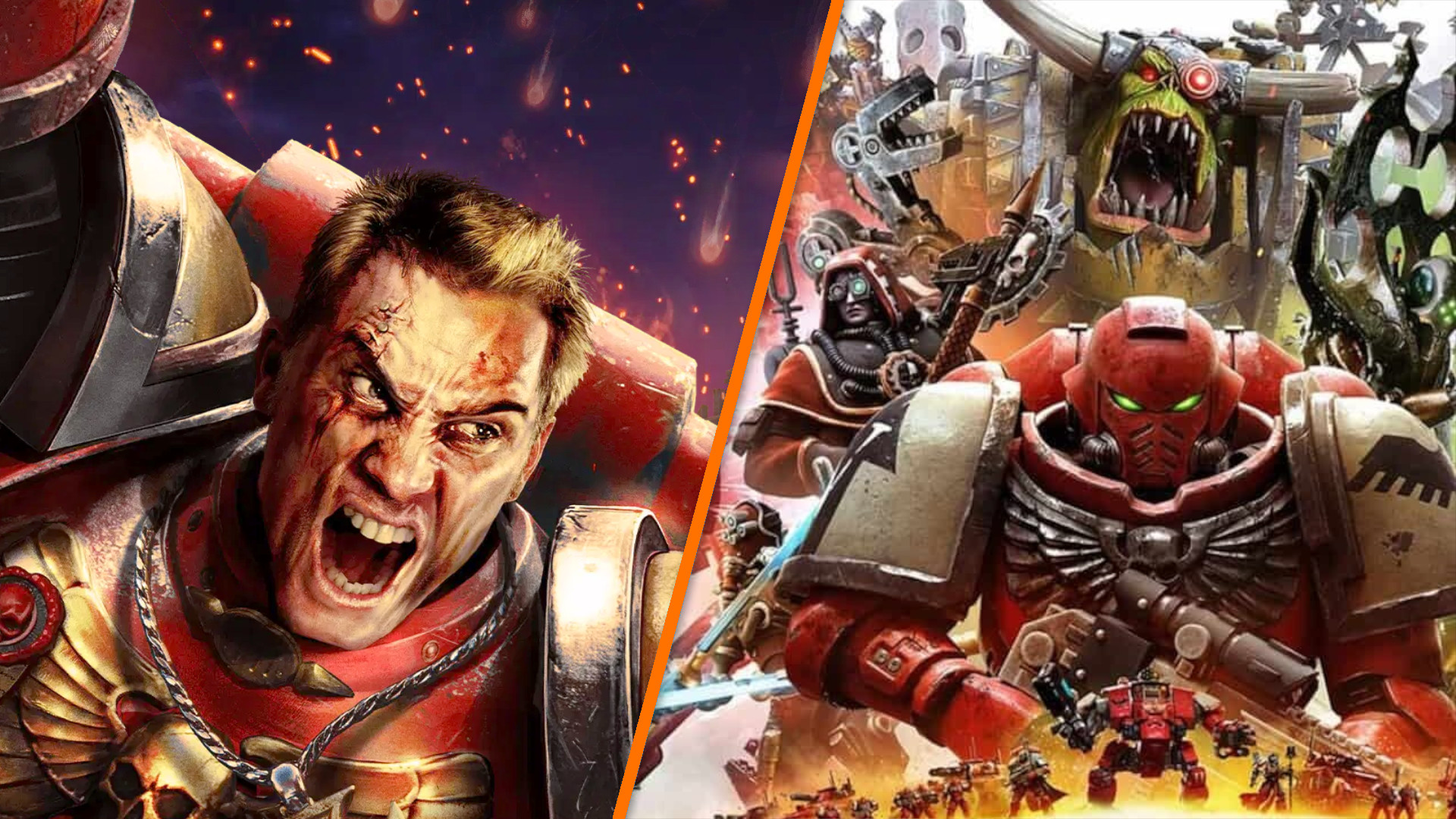
When Dawn of War 4 launches this September, it’s going to be judged against the original Dawn of War. “That’s a terrifying benchmark!” cries Jan Theysen, Creative Director at KING Art Games, the studio developing the latest entry in the venerable RTS series. I interviewed Theysen ahead of the announcement for the game’s release date – here’s what he had to say.
“The original game is fantastic, but it’s also over twenty years old,” Theysen says. “Some things aged beautifully; some absolutely did not.” So what was it important to keep? “We spent a lot of time talking to players about what they actually remembered; what made Dawn of War 1 the game they fell in love with,” Theysen explains. “People remembered massive battles with sync kills; they remembered caring about their units; they remembered defending choke points against impossible odds; they remembered cool voice lines and how everything felt ‘just right.'”
Which – except for the sync kills, a technology that KING Art Games claims to have reproduced and then bettered for Dawn of War 4 – is a list of vibes rather than concrete features. “We’re not competing with Dawn of War 1,” Theysen says, “We’re competing with people’s memory of how it felt to play it.” So the question became: “how do we recreate those feelings with modern design standards?”

“We spent a lot of time dissecting what made the first game special: base-building, map control, huge armies smashing into each other, faction identity, unit customization, all of that,” Theysen says. “We wanted to bring back the feeling of commanding big and brutal battles in the world of Warhammer 40,000.” It’s a reverential approach to the past.
It’s quite a poetic position for a studio making a game set in the Warhammer 40,000 universe to be in. Beyond the bombastic battles and apocalyptic super-weapons, one of the setting’s key themes is the challenge of living in the shadow of a mythical past. The Space Marine Chapters are pale imitations of the ancient Legions, the high technologies of the Adeptus Mechanicus are degraded copies of lost archaeotech, and the statues of dead heroes loom ever larger over their cowering descendants.
You’ll find a similar narrative of lost glories in some web communities devoted to the RTS genre, lamentations about how no modern game will recapture the lost glories of Starcraft 2 or Command and Conquer: Generals. Theysen is a bit more upbeat about the genre. “RTS feels much more alive today than it did ten years ago,” he says, “there has been a constant stream of really good RTS games over the last years, and that’s very different from when we started working on Iron Harvest,” the studio’s first big RTS hit.

Even so, he acknowledges that he hasn’t seen “that one huge RTS release everybody was talking about that suddenly brought millions of new players into the genre again.” But he maintains that “if you combine strong classic RTS gameplay with a memorable universe and great campaigns, I absolutely think there’s still a big audience for it – even if the genre isn’t dominating the mainstream anymore.”
As for who he expects that audience to be, “it’s a mixture of people who fell in love with RTS in its golden age and people who are interested in the worlds and stories.” Nostalgia will be a big motivator: “we expect to excite a lot of DoW fans – especially those who love the first game… and RTS players who might not know the universe super well yet, but who enjoy big, classic strategy games.”
What, exactly, makes a ‘classic strategy game’ is a vexed question. “RTS games ask you to think on multiple layers simultaneously,” Theysen says; “economy, production, scouting, positioning, expansion, timing attacks, long-term planning – that mix is still incredibly compelling and there’s nothing else quite like it.” As for what latter-day titles might be missing, “people massively underestimate how important campaigns are to RTS fans,” Theysen says. “Gameplay is important, but there are many players out there who remember their favorite RTS primarily because of the epic adventure they experienced,” he continues, “the worlds, the atmosphere, the factions and the stories.”
Story and setting were a massive part of the appeal of the original Dawn of War. For 40k fans, it was the most vivid and spectacular depiction of the setting ever made. Theysen points out that there was plenty of travel in the other direction: “for many people the original Dawn of War was their entry point into Warhammer 40,000.” As he puts it, “40k can be a pretty intimidating universe – there are decades of lore, dozens of factions and a lot of very passionate fans, but Dawn of War made that world approachable without losing what made it special.”
“We kept that very much in mind for Dawn of War 4,” Theysen says, “and hope it can become that entry point for a new generation of players as well.”
Another big motif in Warhammer 40,000 stories is something from the past actually reappearing in the present. Sometimes that’s a really, really bad thing – you never want a Necron tomb complex to open up beneath your feet – but at other times, the return of a spirit, a hero, or even just a weapon from the distant past could be humanity’s last, best hope for survival. Dawn of War 4 is wearing the mantle of the original Dawn of War proudly. Will this be the return of the hero the RTS genre needs? We’ll find out very soon.