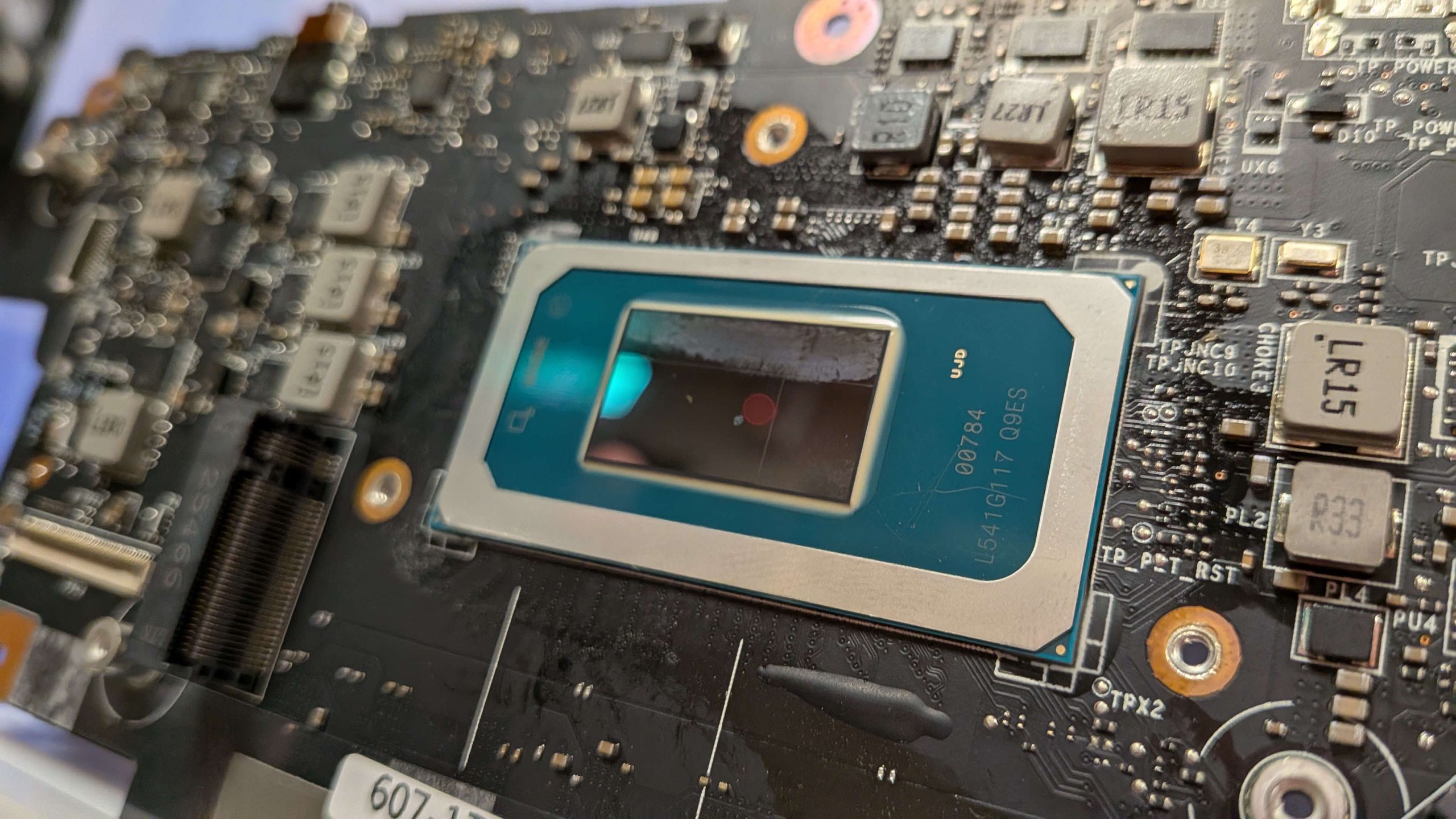
Computex has not even really started yet and already I’ve seen the two most exciting gaming developments I’ll see this week. One is the new Nvidia RTX Spark Arm-based hardware, and the other is Intel’s G3 family of handheld processors. It’s a game-changing bit of hardware that is delivering on the twin pillars of gaming performance and far longer battery life than we’ve seen in a handheld PC up to now.
And all with an x86 CPU at its heart.
But as Intel’s Tom Petersen tells me in downtown Taipei this morning, “you need frame gen to get a good experience” on handheld gaming PCs. But the added latency that’s inevitable with frame generation is still the thing that’s pushing people away from enabling and embracing the feature. Personally, I will happily enable frame gen in games where I’m not going to notice a latency hit (where I’ve already got a high enough input frame rate) and where it’s going to noticeably smooth things out. But it is still an issue when you don’t have a high input frame rate… such as in handhelds.


But is that added latency inevitable with frame gen? “We’re actually going to be reducing that latency,” states Petersen going off script for a moment. “There are two techniques that people like to think about. One is extrapolation.
“Latency is primarily derived from the time it takes to get the second frame. Just because of turning on XeSS MFG, you’re picking up about eight milliseconds of latency. Now that is a big problem, right? That’s why a lot of people don’t like frame gen. In this handheld environment, you actually have more latency in the controllers than that eight milliseconds that we’re talking about, but it’s still not good enough.”
So Intel is planning on doing something about that latency and that means shifting away from the now traditional interpolation method to extrapolation instead. In the current implementation of frame gen it’s the waiting around that introduces the latency problems.
Image 1 of 2


“We got the first frame, and then we waited this whole time until we got a second frame,” says Petersen. “And when we got the second frame, we did all of our magic and generated three frames, and when we got that all done, guess what we did. We showed you the first frame.
“So the first frame has just been sitting around waiting for this entire process to happen, and now we’re ready to show you four frames. So that’s where the latency you feel is coming from.
“With extrapolation, we don’t do that. With extrapolation, we get the first frame and we show it to you, and then instead of waiting for the second frame, we’re using AI to predict where we think you’re going to be. So, thinking about where you’ve been, the direction you’re going, you’re probably going to keep going that way. So, we’re going to predict the frames, we’re going to generate them.
“Now, we’re going to mispredict sometimes—and that’s why extrapolation is hard—but that’s definitely the technology that will change the experience. There’s one more that will make it better, which we’re not ready to talk about yet, but you can do the same projection, the same prediction, without doing extrapolation.”
So, how far away are we from getting extrapolation in our frame gen feature set? I’m expecting the answer to be years off, but Petersen explains that actually, he was hoping to have a demo of the extrapolation technique ready to show off today. But sadly it didn’t make the show alongside the G3 Extreme.
Though if there was even a chance that an extrapolation demo was going to make Computex then maybe it’s not too far off from becoming a reality.

Best handheld PC 2026